Overview
With Operation Epic Fury underway as of February 28, 2026, the Iran vs US military question has moved from academic exercise to immediate operational reality. Any serious Iran US military comparison must account for the fact that these two countries represent radically different models of military power: the US maintains the most expensive, technologically advanced, and globally deployed force in human history, while Iran has built a military designed specifically to survive and impose costs on a superior adversary within its own region.
Comparing these two forces by simple numerical tallies — how many tanks, how many jets, how many ships — is necessary but insufficient. The United States has spent $886 billion on defense in fiscal year 2025 (SIPRI Yearbook 2025), roughly equivalent to the next ten largest military budgets combined. Iran's official defense budget is approximately $15 billion, though actual expenditures including IRGC operations and proxy funding may push the real figure to $25-30 billion according to IISS Military Balance 2026. By every conventional metric — aircraft, warships, precision-guided munitions, satellite intelligence, cyber capability, logistics capacity — the United States holds decisive advantages. On paper, Iran military strength 2026 figures look like a mismatch in nearly every category.
But the relevant question is not "US vs Iran who would win" in a head-to-head engagement — the answer to that is self-evident. The relevant question is: can the United States achieve its stated objectives against Iran at an acceptable cost? That question depends on geography, asymmetric strategy, escalation dynamics, and the willingness of the American public to sustain operations against a country four times the size of Iraq with three times the population. This full Iran vs US military comparison provides the data necessary to think through that question.
Defense Budget Comparison
Military spending is the single most revealing indicator of relative capability because it determines everything from weapons procurement to training quality to logistics capacity. The gap between the United States and Iran is not merely large — it is of a different order of magnitude entirely.
| Category | United States | Iran | Ratio |
|---|---|---|---|
| Total Defense Budget (2025) | $886 billion | ~$15 billion (official) | 59:1 |
| Estimated Real Spending | $886 billion | $25-30 billion (est.) | 30-35:1 |
| Defense as % of GDP | 3.4% | 2.5% (official) | — |
| Per-Soldier Spending | ~$637,000 | ~$24,600 | 26:1 |
| R&D Spending | $145 billion | ~$1.5 billion (est.) | 97:1 |
| Procurement Budget | $170 billion | ~$3 billion (est.) | 57:1 |
The US research and development budget alone ($145 billion) exceeds Iran's entire estimated real defense spending by a factor of five. This R&D expenditure funds programs like the B-21 Raider stealth bomber, the Next Generation Air Dominance (NGAD) fighter program, hypersonic weapons development, and space-based intelligence systems that have no Iranian counterpart whatsoever. According to SIPRI Arms Transfers Database, Iran has been largely locked out of the international arms market since the 1979 revolution, though the expiration of UN arms embargo provisions in 2020 opened limited procurement channels from Russia and China.
Iran's response to this budget gap has been strategic prioritization. Rather than attempting to build a balanced conventional force — which would be financially impossible — Tehran has concentrated resources on its ballistic missile program, proxy network funding, asymmetric naval capabilities in the Persian Gulf, and indigenous drone development. The IRGC's budget, which is separate from the regular military (Artesh) budget and partially opaque even to Iran's own parliament, funds these priority programs. CSIS Iran Threat Assessment estimates that IRGC-related expenditures, including payments to proxy groups, account for $8-12 billion annually — a significant fraction of Iran's total military spending directed toward capabilities designed specifically to offset American advantages.
One area where the budget comparison is misleading is purchasing power parity. A soldier's salary in Iran costs a fraction of a US service member's compensation package. Indigenous missile production in Iran benefits from lower labor costs and no export markups. Nonetheless, the qualitative gap in technology, training, precision munitions stockpiles, and logistics infrastructure is real and cannot be offset by purchasing power adjustments alone.
Personnel and Ground Forces
Assessing Iran military power on the ground requires understanding a dual military structure unique in the region. The conventional military, the Artesh, fields approximately 350,000 active-duty personnel across army, navy, and air force branches. Alongside it operates the Islamic Revolutionary Guard Corps (IRGC), with approximately 190,000 active members including the ground forces, naval forces, aerospace division, and the elite Quds Force responsible for external operations. Behind both stands the Basij, a volunteer paramilitary force under IRGC command that can mobilize an estimated 600,000 to 1 million personnel in wartime, though their training and equipment levels vary dramatically (IISS Military Balance 2026).
| Category | United States | Iran |
|---|---|---|
| Active Military Personnel | 1,390,000 | 610,000 |
| Reserve Personnel | 845,000 | 350,000 (Artesh reserve) |
| Paramilitary | — | 600,000-1,000,000 (Basij) |
| Main Battle Tanks | 5,500 (M1 Abrams) | 1,513 (mixed, many obsolete) |
| Armored Fighting Vehicles | 45,193 | 2,345 |
| Self-Propelled Artillery | 1,498 | 580 |
| MLRS | 1,366 | 1,476 |
The US Army's M1A2 SEPv3 Abrams main battle tank represents the apex of armored warfare technology: a 70-ton platform with composite and reactive armor, 120mm smoothbore gun, advanced fire control systems, and networked battlefield awareness. Iran's tank fleet is a patchwork of approximately 480 T-72S tanks (purchased from Russia in the 1990s), roughly 100 domestically produced Karrar tanks (based on T-72 design), aging M60 Pattons and Chieftain Mark 5 tanks from pre-revolution British and American stocks, and smaller numbers of T-54/55 and Type 59 tanks. Many of these vehicles are 40-50 years old with maintenance challenges exacerbated by sanctions on spare parts.
However, a ground force comparison focusing on tank counts is misleading for the Iran scenario. The US would need to deploy forces across 12,000 kilometers of supply lines to reach Iran, while Iranian forces operate on interior lines within their own territory. The IRGC Ground Forces are organized specifically for territorial defense, with regional commands structured to fight independently if communications are severed. Basij units, while lightly equipped, are organized at the neighborhood and village level across Iran's population centers, creating a potential resistance infrastructure that no invading force could ignore.
The US military's critical personnel advantage is not in numbers but in training, doctrine, and integration. American forces conduct large-scale combined arms exercises regularly, operate under a unified joint command structure tested in multiple conflicts, and benefit from non-commissioned officer (NCO) corps that enables initiative at the tactical level. Iran's dual command structure (Artesh vs. IRGC) creates coordination challenges, and the IRGC's selection criteria prioritize ideological loyalty alongside military competence — a dynamic that can degrade operational effectiveness.
Air Power Comparison
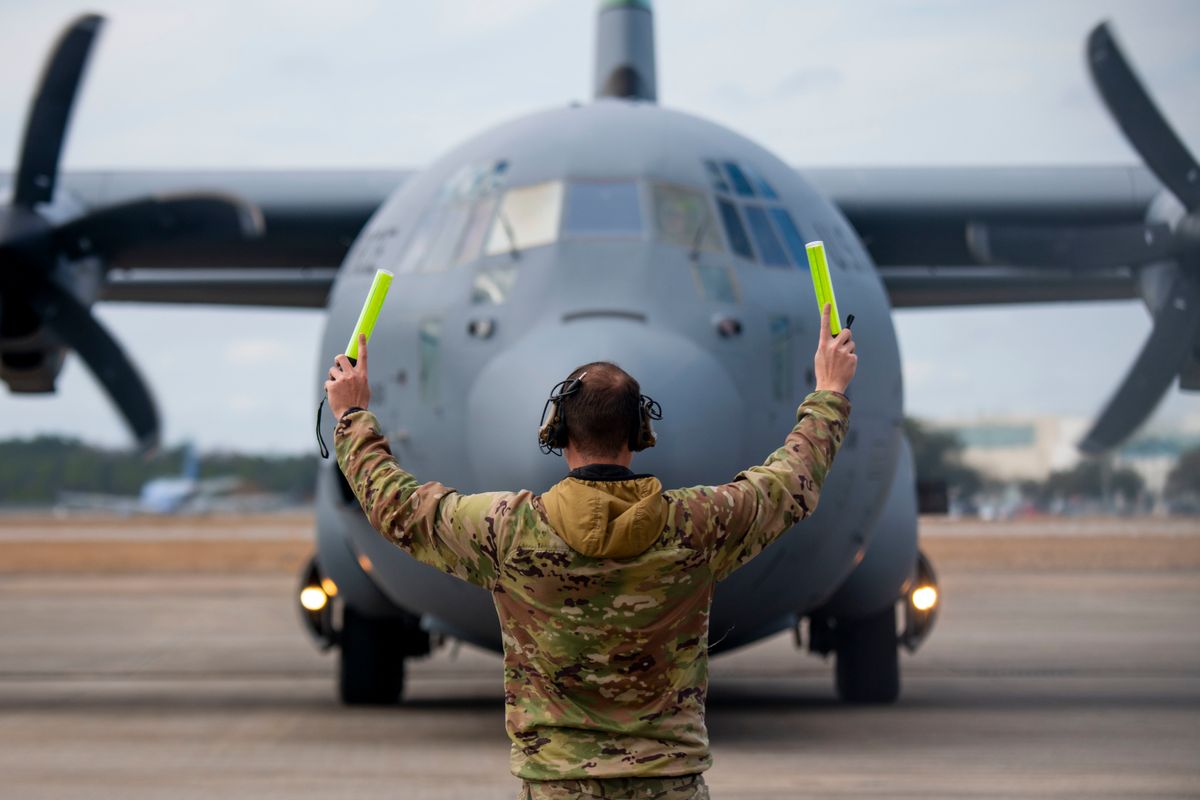
The air power gap is the single most decisive conventional asymmetry in the Iran vs US military balance, and it is the reason that Operation Epic Fury has thus far been conducted primarily through aerial and naval strike operations rather than ground maneuver. For anyone asking US vs Iran who would win in the skies, the numbers leave little room for debate.
| Category | United States | Iran |
|---|---|---|
| Total Aircraft | 13,300 | ~551 |
| Fighter/Attack Aircraft | 1,957 | ~186 |
| 5th-Generation Fighters | ~620 (F-22, F-35) | 0 |
| Bombers | 162 (B-1B, B-2, B-52) | 0 |
| Transport Aircraft | 982 | 86 |
| Helicopters (Total) | 5,584 | ~126 |
| Attack Helicopters | 910 (AH-64 Apache) | ~12 (AH-1J Cobra) |
| Tanker Aircraft | 625 | 3-4 |
| UAVs (Major Types) | Hundreds (MQ-9, RQ-4, etc.) | Hundreds (Shahed, Mohajer, etc.) |
The US Air Force, Navy, and Marine Corps collectively operate approximately 1,957 dedicated fighter and attack aircraft, including the F-22 Raptor (air superiority stealth fighter with no peer competitor), the F-35 Lightning II (multi-role stealth fighter deployed across all services), and large fleets of F-15E Strike Eagles, F-16 Fighting Falcons, and F/A-18E/F Super Hornets. The B-2 Spirit stealth bomber can deliver 40,000 pounds of precision-guided munitions from bases in Missouri to targets anywhere on Earth with aerial refueling, as demonstrated by its use in the opening hours of Operation Epic Fury. The newer B-21 Raider, while not yet confirmed as operational in the Iran theater, represents a generational advance in penetrating bomber capability (DoD Annual Report to Congress, FY2025).
Iran's air force, the Islamic Republic of Iran Air Force (IRIAF), is essentially a museum of Cold War-era aircraft supplemented by limited domestic production. The most capable platforms in Iran's inventory are approximately 25-30 F-14A Tomcats (delivered before the 1979 revolution and maintained through extraordinary improvisational engineering), roughly 24 MiG-29 Fulcrums (purchased from Russia in the 1990s), approximately 60 F-4 Phantom IIs, and 24 F-5 Tiger IIs — all 1960s and 1970s designs. Iran's domestically produced Kowsar fighter is essentially a reverse-engineered F-5 with updated avionics, and its Qaher-313 stealth fighter program has produced only prototypes of questionable capability. None of these aircraft would survive in contested airspace against F-22s or F-35s equipped with modern air-to-air missiles and supported by AWACS early warning aircraft.
Where Iran has partially closed the air power gap is in unmanned aerial vehicles. The Shahed-136 one-way attack drone (used extensively by Russia in Ukraine) is produced in large numbers and costs an estimated $20,000-50,000 per unit — far less than the interceptor missiles used to shoot it down. Iran's Mohajer-6 and Ababil-3 reconnaissance drones provide tactical intelligence capability, and the Shahed-149 Gaza medium-altitude long-endurance drone is Iran's attempt at replicating MQ-9 Reaper capabilities. However, these systems are vulnerable to electronic warfare and air defense systems that the US deploys in abundance.
Naval Forces
The US Navy is the most powerful maritime force in history, and the disparity with Iran's naval capabilities is even more extreme than the air power gap when measured in blue-water terms. However, the Persian Gulf's confined geography partially negates America's oceanic advantages and creates conditions where Iran's asymmetric naval strategy has genuine tactical relevance.
| Category | United States | Iran |
|---|---|---|
| Aircraft Carriers | 11 (nuclear-powered) | 0 |
| Submarines (Nuclear) | 68 (SSN/SSBN/SSGN) | 0 |
| Submarines (Diesel) | 0 | 3 Kilo-class + ~20 midget subs |
| Destroyers | 72 (Arleigh Burke-class) | 0 |
| Frigates | 0 (Constellation-class under construction) | 5 |
| Fast Attack Craft | ~10 | ~230 |
| Mine Warfare Vessels | 11 | ~10 + mine-laying capability on multiple platforms |
| Total Naval Personnel | 347,000 | 28,000 (IRIN + IRGCN) |
The US Navy deploys 11 nuclear-powered aircraft carriers, each carrying 60-75 aircraft and serving as the centerpiece of a carrier strike group that includes guided-missile cruisers, destroyers, and attack submarines. Two carrier strike groups — the USS Abraham Lincoln (CVN-72) and USS Gerald R. Ford (CVN-78) — are currently operating in the theater. Each Arleigh Burke-class destroyer carries 90-96 Mk 41 Vertical Launch System cells capable of firing Tomahawk cruise missiles, Standard Missile variants for air defense, and ASROC anti-submarine torpedoes. The firepower of a single US destroyer exceeds that of Iran's entire surface fleet.
Iran's naval strategy explicitly avoids attempting to match the US Navy ship-for-ship. Instead, the IRGC Navy (IRGCN) operates approximately 230 fast attack craft — small, fast boats armed with anti-ship cruise missiles, rockets, and machine guns — designed for swarm tactics in the confined waters of the Persian Gulf and the Strait of Hormuz. The strait is only 33 kilometers wide at its narrowest point, and its shipping lanes run through waters where small boats can launch missiles and retreat to hidden coastal positions within minutes. Iran also maintains an inventory of anti-ship cruise missiles including the Noor (based on Chinese C-802), Ghader, and Khalij Fars (an anti-ship ballistic missile), which can be launched from shore batteries concealed along Iran's 2,440-kilometer Persian Gulf coastline (CSIS Iran Threat Assessment).
The mine warfare threat deserves specific attention. Iran possesses an estimated 3,000-5,000 naval mines of various types, from simple contact mines to more sophisticated influence mines. During the 1988 "Tanker War," a single Iranian mine severely damaged the USS Samuel B. Roberts (FFG-58). The Strait of Hormuz's shallow waters and heavy commercial traffic make mine clearance operations slow, dangerous, and potentially disruptive to global oil shipping even if only a few hundred mines are deployed. Iran's three Kilo-class submarines (purchased from Russia in the 1990s), while aging, are diesel-electric boats that are exceptionally quiet when running on battery power in shallow Gulf waters, creating a submarine threat that US anti-submarine warfare assets must respect.
Missile Arsenals
Iran's ballistic and cruise missile program is the area where any straightforward Iran US military comparison becomes more nuanced. While the US possesses overwhelmingly superior missile technology in qualitative terms, Iran has the largest ballistic missile arsenal in the Middle East — and the geographic proximity of US bases means those missiles do not need intercontinental range to be strategically significant. This is the single category where Iran military strength 2026 numbers carry genuine strategic weight.
Iran operates an estimated 3,000+ ballistic missiles across multiple families, stored in hardened underground facilities (so-called "missile cities") dispersed throughout the Zagros and Alborz mountain ranges. The inventory includes short-range systems like the Fateh-110/Fateh-313 (300-500 km range, solid-fuel, CEP under 100 meters), medium-range theater missiles like the Shahab-3/Emad (1,300-1,700 km range, reaching Israel and Turkey), and longer-range systems like the Khorramshahr (estimated 2,000+ km, reaching southeastern Europe). Iran also fields the Sejjil-2, a solid-fuel medium-range missile that can be launched on shorter notice than liquid-fueled variants.
The United States, by contrast, retired its ground-launched intermediate-range ballistic missiles under the 1987 INF Treaty and has only recently begun developing new conventional ground-launched systems following treaty withdrawal in 2019. However, the US possesses far more lethal delivery systems in practice: Tomahawk cruise missiles (1,600+ km range, sub-10-meter accuracy) launched from ships and submarines, air-launched cruise missiles (JASSM-ER, 1,000+ km range), and precision-guided bombs (JDAM, SDB, Paveway series) delivered by stealth aircraft that can penetrate Iranian airspace with near-impunity. The GBU-57 Massive Ordnance Penetrator (30,000 pounds, designed to penetrate 60+ meters of earth and concrete) was purpose-built for targets like Iran's Fordow enrichment facility.
The critical difference is survivability and saturation. Iran's dispersed, underground missile force is designed to survive a first strike and launch retaliatory salvos that overwhelm missile defense systems through sheer volume. US missile defense in the region — Patriot PAC-3, THAAD, and ship-based Aegis/SM-3 — has limited magazine depth. A salvo of 100+ Iranian ballistic missiles launched simultaneously against a single base would likely saturate defensive systems, with even a 90% interception rate meaning 10 warheads reaching their targets. This arithmetic is Iran's primary deterrent.
Nuclear Capability Gap
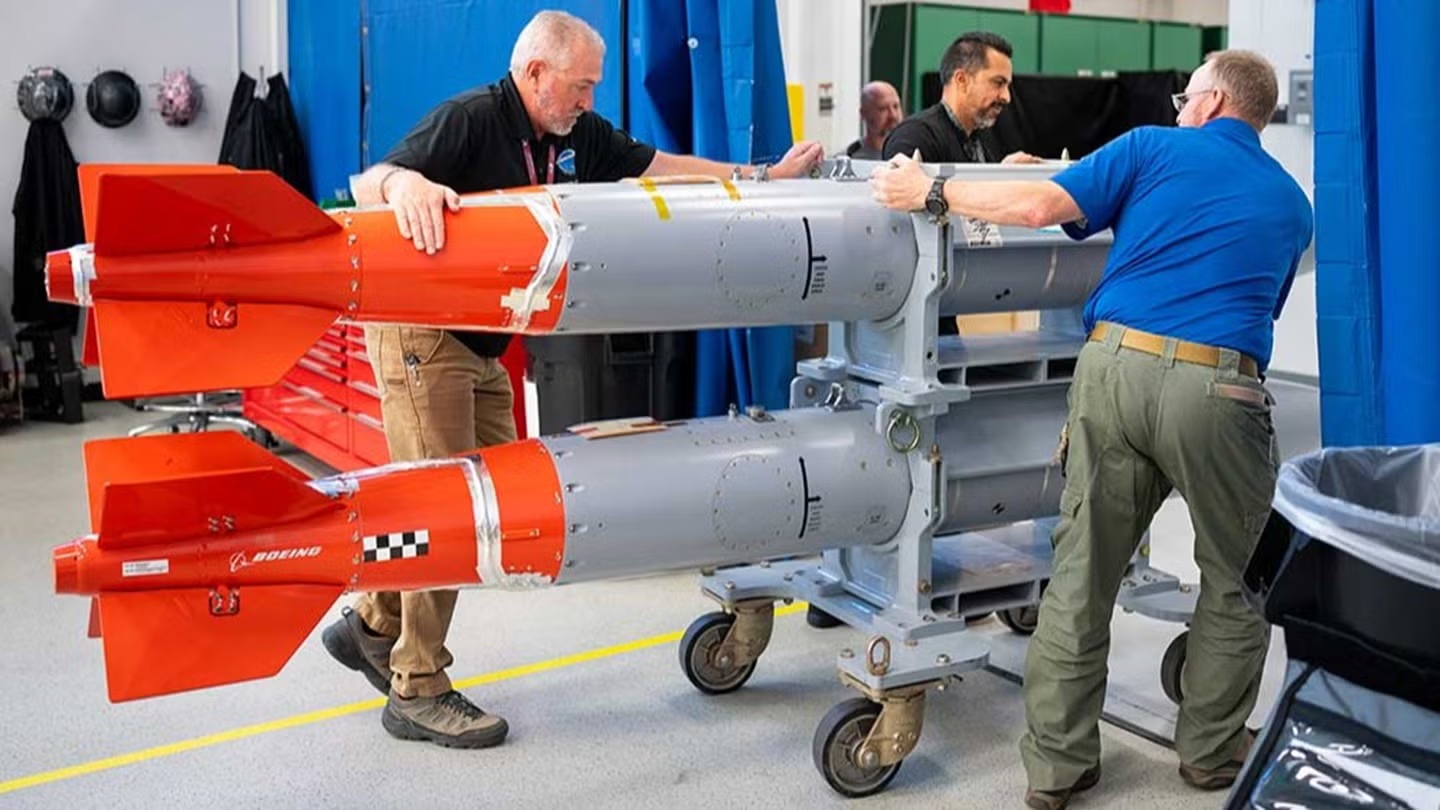
The nuclear dimension is the most consequential asymmetry in the entire Iran vs US military balance. The United States maintains a nuclear triad of approximately 5,550 nuclear warheads (1,700 deployed) deliverable by intercontinental ballistic missiles (Minuteman III), submarine-launched ballistic missiles (Trident II D5), and strategic bombers (B-2, B-52). This arsenal provides absolute deterrence against any state adversary and represents an asymmetry that no Iranian conventional or asymmetric capability can offset.
Iran does not currently possess nuclear weapons. The IAEA's most recent reporting (prior to the current conflict disrupting inspections) indicated that Iran had enriched uranium to 60% purity and possessed stockpiles sufficient, if further enriched to weapons-grade (90%+), to produce fissile material for multiple devices. The breakout timeline — the time needed to produce enough weapons-grade uranium for a single device — was estimated at 1-2 weeks by US intelligence assessments, though weaponization (building an actual deliverable weapon) would take additional months to years depending on Iran's covert progress on warhead design and miniaturization (IISS Strategic Dossier: Iran's Nuclear Program).
The nuclear gap is both the most important asymmetry and one of the primary drivers of the current conflict. The US and Israel launched Operation Epic Fury in significant part to prevent Iran from crossing the nuclear threshold. Paradoxically, the strikes themselves may accelerate Iran's motivation to acquire a nuclear deterrent — the lesson of Libya, Iraq, and Ukraine being that states without nuclear weapons are vulnerable to regime-threatening military action. Whether Operation Epic Fury has physically destroyed enough enrichment infrastructure to extend Iran's breakout timeline is the central unresolved question of the current conflict.
Cyber Warfare Capabilities
Cyber warfare is one of the few domains where Iran has demonstrated capability to reach American territory, if not in a kinetic sense then in an operationally meaningful one. The United States operates US Cyber Command (CYBERCOM), a unified combatant command with approximately 6,200 personnel organized into 133 Cyber Mission Force teams. Its offensive capabilities are classified but are understood to include the ability to disrupt adversary military networks, critical infrastructure, and communications systems. The Stuxnet operation (attributed to US and Israeli intelligence) that damaged Iranian centrifuges at Natanz between 2007 and 2010 remains the most significant publicly known cyber-physical attack in history.
Iran has developed a significant cyber capability relative to its overall technological base. Iranian state-sponsored groups — including APT33 (Elfin), APT34 (OilRig), APT35 (Charming Kitten), and MuddyWater — have conducted operations against US financial institutions (the 2012-2013 DDoS attacks on Bank of America, JPMorgan Chase, and other major banks), Saudi Aramco (the 2012 Shamoon wiper attack that destroyed 30,000 workstations), and critical infrastructure targets. In 2023, an Iranian-linked group compromised a water treatment facility in Aliquippa, Pennsylvania, demonstrating the ability to reach into US operational technology networks (CISA Advisory AA24-011A).
The current conflict has already triggered a spike in Iranian cyber operations. CISA issued an advisory on February 27, 2026, warning critical infrastructure operators of increased scanning and probing activity attributed to Iranian state-sponsored actors, particularly targeting energy, water, transportation, and healthcare sectors. While Iran's cyber forces cannot match the US in sophistication or scale, they represent a credible capability to impose costs on the American homeland in a domain where geographic distance provides no protection — a unique feature of the Iran-US military balance that has no parallel in the conventional force comparison.
Asymmetric Warfare Advantages
When analysts assess Iran military power beyond conventional hardware, its most strategically significant asset is not a weapons system but a network. The IRGC Quds Force — commanded since 2020 by Brigadier General Esmail Qaani following the US assassination of Qasem Soleimani — coordinates a constellation of allied militias, political movements, and armed groups across at least seven countries. This "Axis of Resistance" provides Iran with the ability to threaten American interests and allies across a geographic arc stretching from Lebanon to Yemen without deploying a single Iranian soldier.
The proxy network includes: Hezbollah in Lebanon (estimated 30,000-50,000 fighters, 150,000+ rockets and missiles), the Houthis (Ansar Allah) in Yemen (who have demonstrated anti-ship missile and drone capability against commercial shipping in the Red Sea), Hashd al-Shaabi (PMF) militia networks in Iraq (over 100,000 fighters, including Kata'ib Hezbollah and Asa'ib Ahl al-Haq, with regular rocket and drone attacks on US bases), Hamas and Palestinian Islamic Jihad in Gaza, and smaller Shia militia groups in Syria, Afghanistan, and Pakistan.
This network gives Iran strategic depth that no amount of conventional military spending can replicate. If the US strikes Iran, Hezbollah can launch rockets at Israel, Houthis can attack shipping in the Red Sea and Bab el-Mandeb strait, Iraqi militias can target the 2,500 US troops in Iraq, and sleeper networks can potentially conduct operations against US interests globally. The cost of countering this distributed threat is enormous — the US would need to simultaneously fight Iran, defend against proxy attacks across multiple theaters, protect commercial shipping, and maintain homeland security against potential terrorist operations. This is Iran's theory of victory: not defeating the United States militarily, but making the cost of conflict so high across so many dimensions that Washington concludes the objectives are not worth the price.
Iran's drone proliferation strategy extends this asymmetric advantage. By supplying Shahed-136 attack drones, Mohajer-6 reconnaissance drones, and anti-ship drone boats to proxy groups, Iran has democratized precision strike capability across its alliance network. The Houthi attack on Saudi Aramco's Abqaiq facility in September 2019, using Iranian-supplied drones and cruise missiles, temporarily knocked out 5.7 million barrels per day of oil production — approximately 5% of global supply — demonstrating the strategic significance of this approach.
Air Defense Systems
Iran's air defense network is the most critical factor determining whether US airstrikes can achieve their objectives at acceptable cost. The network is layered, increasingly indigenous, and was significantly tested in the opening hours of Operation Epic Fury.
Iran's most capable system prior to the current strikes was the Russian-supplied S-300PMU-2, delivered in 2016 after years of delayed transfer. Approximately four batteries were deployed to protect high-value sites including Isfahan, Bushehr, Tehran, and the approaches to Fordow. The S-300PMU-2 can engage targets at ranges up to 200 km and altitudes up to 27 km, with the ability to track and engage multiple targets simultaneously. However, the system dates to the 1970s Soviet design lineage, and the US has had decades to develop countermeasures. The F-22 and F-35's stealth characteristics significantly reduce the S-300's effective engagement range.
Iran's indigenous air defense systems include the Bavar-373, which Iran describes as equivalent to the Russian S-300 (Western assessments are skeptical), the Khordad-15 (medium-range, designed with anti-stealth capabilities that Iran claims but which remain unverified), the Mersad (upgraded Hawk system), and numerous shorter-range systems including the Sayyad-2 and Rapier variants. The 3rd Khordad system gained notoriety when it shot down a US RQ-4A Global Hawk drone over the Strait of Hormuz in June 2019, demonstrating functional capability against at least some modern targets.
The fundamental problem for Iran's air defenses is magazine depth and saturation. The US can launch hundreds of cruise missiles (Tomahawk, JASSM-ER) simultaneously, preceded by electronic warfare jamming from EA-18G Growler aircraft and potentially cyber attacks on radar networks. Each interceptor missile Iran fires depletes a finite supply that cannot be easily replenished under wartime conditions and sanctions. Early reports from Operation Epic Fury indicate that SEAD (Suppression of Enemy Air Defenses) operations successfully degraded multiple S-300 battery positions in the first wave, consistent with standard US doctrine of eliminating air defenses before committing strike packages to defended airspace.
Terrain and Geography Factors
No Iran vs US military comparison is complete without terrain. Geography is Iran's most durable military advantage — one that no amount of American spending can eliminate. Iran encompasses 1,648,195 square kilometers (roughly the size of Alaska), making it the 17th-largest country in the world and more than four times the size of Iraq. Its terrain is dominated by two major mountain ranges: the Zagros Mountains running northwest to southeast along the Iraqi and Turkish borders (peaks exceeding 4,400 meters) and the Alborz Mountains spanning the northern border along the Caspian Sea (including Mount Damavand at 5,609 meters, the highest peak in the Middle East). Between these ranges lies the Iranian Plateau, an arid interior with limited road networks connecting population centers.
For military operations, this geography creates several critical implications. Ground invasion routes are limited: the western approach from Iraq through the Zagros passes is the only viable axis for large armored formations, but these passes are narrow, easily defended, and would channel attacking forces into kill zones. The southern coast along the Persian Gulf is low-lying but backed by mountains within 50-100 kilometers, limiting the depth of any amphibious operation. The eastern border with Afghanistan and Pakistan offers no viable approach for a Western force. The northern border along the Caspian Sea is bounded by mountains and politically impossible routes through Russian or Turkish territory.
Iran's population of approximately 88 million (2026 estimate) is distributed across major urban centers — Tehran (metro area ~16 million), Isfahan (~5 million), Mashhad (~3.5 million), Tabriz (~2 million), and Shiraz (~2 million) — connected by road and rail networks that run through mountain passes and across vast desert stretches. An occupying force would need to control these population centers while maintaining supply lines across a country where the distance from the Iraqi border to Tehran alone is approximately 550 kilometers of mountainous terrain.
The Zagros Mountains specifically are honeycombed with Iran's most sensitive military installations, including the underground missile bases, nuclear research facilities, and IRGC command bunkers. Decades of tunneling have created a network of hardened facilities that can survive conventional airstrikes and in some cases even the GBU-57 bunker buster. The terrain also provides natural concealment for road-mobile missile launchers, making the "Scud hunt" problem that plagued coalition forces in the 1991 Gulf War exponentially more difficult across Iran's vastly larger territory (DoD Annual Report to Congress, FY2025).
Key Takeaways
This Iran vs US military comparison reveals a paradox that has defined asymmetric conflicts throughout modern history: overwhelming conventional superiority does not guarantee strategic success. The United States can destroy any fixed target in Iran, achieve air supremacy within days, and sink Iran's entire navy in a single engagement. But "winning" a conflict with Iran requires achieving political objectives — eliminating the nuclear program, changing regime behavior, or achieving regime change — that cannot be accomplished through air and naval power alone. Anyone searching US vs Iran who would win will find the answer depends entirely on how "winning" is defined.
The key asymmetries that shape the current conflict are:
- Air supremacy is functionally guaranteed. Iran's air force cannot contest US control of the skies, and its air defense network, while more capable than Iraq's in 2003, will be degraded within the first 48-72 hours of sustained SEAD operations. This allows the US to strike any surface target with near-impunity.
- Iran's missile force is its primary deterrent. The dispersed, underground, road-mobile missile arsenal can survive air campaigns and deliver retaliatory strikes against US bases, allied capitals, and economic infrastructure across the region. Missile defense can reduce but not eliminate this threat.
- The proxy network extends the battlefield. Iran can impose costs on the US and its allies across multiple theaters simultaneously, forcing Washington to defend everywhere while attacking Iran specifically.
- Geography makes occupation impossible without mobilization. The RAND Corporation estimated in its 2009 study that a ground invasion and occupation of Iran would require 500,000-1,000,000 troops — a commitment that would require either a draft or the redeployment of forces from every other global commitment.
- The nuclear question creates time pressure. Every day the conflict continues without confirmed destruction of Iran's enrichment capability increases the probability that Iran will accelerate toward a nuclear weapon, which would permanently alter the strategic equation.
The bottom line of this Iran military strength 2026 assessment: the United States is overwhelmingly stronger than Iran by every conventional metric. But Iran has specifically designed its military to make that superiority insufficient for achieving America's most ambitious objectives. The outcome of the current conflict will depend not on who has more aircraft or ships, but on whether American air and naval power can achieve the specific strategic objectives that motivated Operation Epic Fury — and whether Iran's asymmetric toolkit can impose costs high enough to change the political calculus in Washington. In the final analysis, Iran military power is not measured by what it can destroy but by what it can make unacceptably costly.
Related Coverage
- Operation Epic Fury Explained: Targets, Strategy, and What Comes Next
- Iran's Air Defense Systems: Can Iran Shoot Down US Jets?
- Iran Missile Range Map: What the Ranges Mean for US Bases
- US Military Buildup Near Iran: Where American Forces Are Positioned
- Will There Be a Ground Invasion of Iran?
Research Hubs
- Iran-Israel-Dubai War Guide
- Iran Nuclear and Military Briefing
- Israel Security and Escalation Briefing
- Dubai and UAE Risk Briefing
- Source Center: Primary References
Sources
- International Institute for Strategic Studies (IISS), The Military Balance 2026, Chapter 7: Middle East and North Africa. iiss.org
- Stockholm International Peace Research Institute (SIPRI), "Military Expenditure Database 2025," and "Arms Transfers Database." sipri.org
- Center for Strategic and International Studies (CSIS), "Iran Threat Assessment: Military Capabilities and Asymmetric Strategy," January 2026. csis.org
- US Department of Defense, "Annual Report to Congress on Military Power of Iran," FY2025. defense.gov