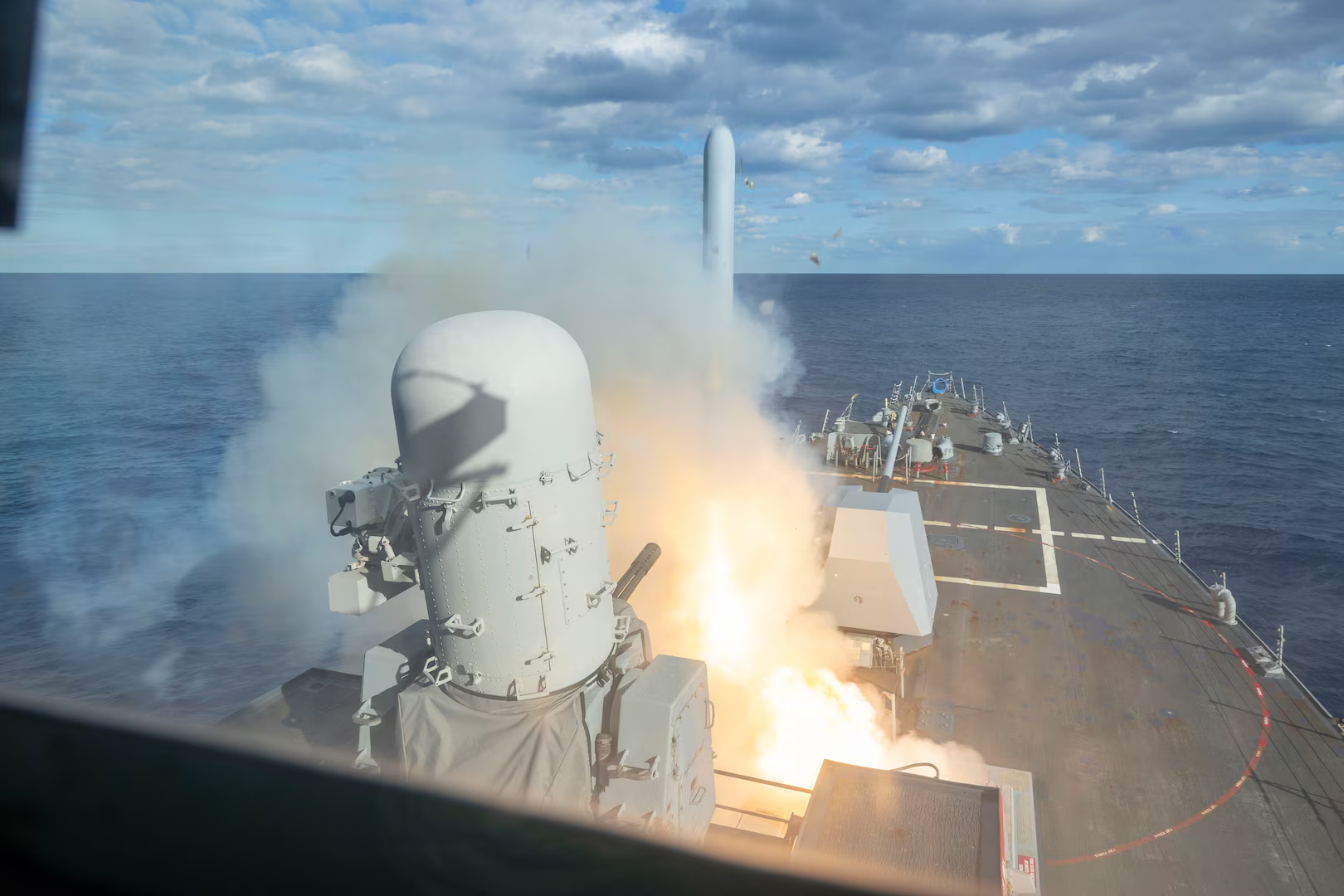
Overview: What Is Operation Epic Fury?
Operation Epic Fury was the Pentagon's public codename for the U.S. side of the February 28, 2026 strikes on Iran. Named reporting consistently described it as part of a coordinated U.S.-Israeli operation, but the public record was stronger on the fact of the operation than on the exact size, exact target list, or exact operational sequencing.
The most useful way to read the operation is therefore as a publicly reported military framework: a large joint strike campaign aimed at Iranian nuclear, missile, and military infrastructure, with public claims about exact effects trailing behind the more basic fact of the attack itself.
Codename Origins and Joint Designations
US military operations receive their codenames through a structured process managed by the Joint Staff at the Pentagon. Codenames are drawn from the Code Word, Nickname, and Exercise Term System (NICKA), a classified database that assigns two-word combinations to operations, exercises, and programs. The first word is typically assigned randomly from a block allocated to the specific combatant command, while the second word is chosen to be memorable without revealing operational details. In the case of Epic Fury, the designation was assigned by US Central Command (CENTCOM), which oversees all military operations in the Middle East. (Pentagon briefing)
The Israeli designations carry more deliberate symbolic weight. "Operation Shield of Judah" (Hebrew: Magen Yehuda) references the biblical Tribe of Judah, one of the twelve tribes of Israel and the lineage of King David. The lion is the traditional symbol of the tribe, which connects to the secondary designation "The Roar of the Lion" (She'agat Ha'Aryeh). Israeli Defense Minister Israel Katz explicitly invoked this symbolism in his announcement, stating that Israel was acting "to remove the existential threat posed by the terrorist regime" in a manner consistent with the nation's historical mandate of self-preservation. (Reuters)
The dual naming convention is not unusual in coalition operations. During the 2011 intervention in Libya, for instance, the US contribution was designated Operation Odyssey Dawn while NATO's broader campaign was called Operation Unified Protector. The arrangement allows each nation to maintain sovereign control over its forces while operating under a shared strategic framework. In this case, coordination between the US and Israeli operations is managed through a Combined Air Operations Center (CAOC) at Al Udeid Air Base in Qatar, where American, Israeli, and allied liaison officers deconflict airspace, assign targets, and sequence strike packages. (AP)
Pentagon officials have emphasized that the name was generated procedurally and should not be interpreted as a statement of intent regarding the duration or intensity of operations. However, several retired military officers appearing on cable news networks noted that the word "Fury" carries an unmistakable connotation of sustained, overwhelming force, a signal they interpreted as deliberate. (NBC News)
Operational Scope and Targets
Named reporting and briefings consistently described four broad target categories: nuclear infrastructure, ballistic missile and cruise-missile production, IRGC command-and-control nodes, and integrated air-defense systems. That broad framing is well supported. What is less clear in the public record is the exact number of cities, exact number of aim points, and exact condition of each site after the strikes.
The safest summary is that the operation was geographically broad and focused on high-value military and nuclear-linked infrastructure. It is much harder, based on the public record alone, to treat every detailed target list as equally confirmed.
Weapons and Platforms Used
Public reporting repeatedly referenced B-2 bombers, bunker-busting munitions, cruise missiles, carrier-based aircraft, and electronic-warfare support. Those categories are the strongest part of the public record. The weaker part is the move from "these systems were reportedly used" to highly precise claims about sortie counts, munitions totals, or exact weapons-per-target without a later official accounting.
For readers, the key point is not the exact loadout of every wave. It is that the operation drew on the kinds of U.S. capabilities associated with hardened targets and long-range strike support, and that this was widely reported as a larger and more complex package than the earlier June 2025 operation.
Comparison to Previous Operations
Operation Epic Fury was repeatedly described as larger and more ambitious than Operation Midnight Hammer. That comparison is strongest at the level of concept: broader target categories, a more expansive campaign logic, and more visible coordination with Israel.
It is weaker when it turns into exact side-by-side sortie or aim-point tables without a fully settled public accounting. This page now keeps the comparison at the level most clearly supported by named reporting: a wider, harder, and more openly integrated campaign than the earlier strike cycle.
Iranian Response and Countermeasures
Iran's response to Operation Epic Fury began quickly, and named reporting linked it to missile salvos, air-defense activation, internet restrictions, and heightened proxy alerting. The important distinction is that public reporting strongly supported the fact of retaliation, while specific claims about exact missile types, exact intercept counts, or exact proxy tasking remained less settled.
The operation therefore needs to be read as the opening of a wider exchange rather than as a one-sided strike whose effects can be understood in isolation.
Congressional and Legal Questions
Operation Epic Fury has reignited fierce debate in Congress over the constitutional limits of presidential war-making authority. Under the War Powers Resolution of 1973, the president may commit US armed forces to military action for up to 60 days without congressional authorization, provided he notifies Congress within 48 hours. The White House submitted a formal notification to congressional leadership at approximately 3:00 a.m. Eastern Time on February 28, shortly before the first strikes hit Iranian territory. The notification cited Article II of the Constitution, which grants the president authority as Commander-in-Chief, and invoked the inherent right of self-defense under Article 51 of the UN Charter. (AP)
The legal justification rests on two primary claims. First, the administration argues that Iran's nuclear program constituted an "imminent threat" to the United States and its allies, meeting the threshold for preemptive self-defense. Second, the White House pointed to Iranian-backed attacks on US military personnel in Iraq and Syria over the preceding months as evidence of an ongoing armed conflict that falls within the president's existing authority to defend US forces. Critics have challenged both arguments. Senator Tim Kaine (D-VA), a longtime advocate for constraining executive war powers, issued a statement within hours calling the strikes "a massive escalation undertaken without the consent of the American people's representatives" and announced he would introduce a War Powers Resolution requiring the president to withdraw forces from hostilities within 30 days unless Congress votes to authorize continued operations. (NBC News)
Congressional reaction split largely along partisan lines, though not entirely. Senate Minority Leader Chuck Schumer (D-NY) called for an emergency classified briefing and declined to endorse or condemn the operation pending further information. Several Republican senators, including Lindsey Graham (R-SC) and Tom Cotton (R-AR), expressed strong support, with Graham declaring the strikes "long overdue." However, Senator Rand Paul (R-KY) broke with his party, calling the operation "an unconstitutional act of war" and pledging to join Kaine's resolution. On the House side, Speaker Mike Johnson issued a statement supporting the president's authority to "defend the nation against nuclear threats," while members of the Progressive Caucus announced plans to force a floor vote on a Privileged Resolution under the War Powers Act. (Pentagon briefing)
International law scholars have raised additional questions about whether the strikes meet the legal standard of "necessity and proportionality" required for lawful self-defense under international law. The International Court of Justice (ICJ) has historically applied a strict interpretation of imminence, requiring evidence that an armed attack is about to occur or is already underway. The US claim of preemptive self-defense against a nuclear program, while politically compelling, lacks clear precedent in international jurisprudence and is likely to face challenge at the UN Security Council. (CSIS)
What Can Be Verified So Far
This page is strongest when it separates direct reporting from inference.
- Directly supported: a major coordinated U.S.-Israeli operation occurred on February 28, 2026, and public reporting tied it to nuclear, missile, command, and air-defense targets.
- Supported but still fluid: exact target counts, exact underground damage, exact munitions totals, and the long-term effect on Iran's military and nuclear posture.
- More interpretive than proven: claims that the operation had already achieved irreversible strategic results or that every reported technical detail from the first day was fully confirmed.
What Comes Next
The immediate trajectory of Operation Epic Fury depends on several interrelated variables. Pentagon officials have stated that the operation is planned as a "multi-phase campaign" rather than a single strike event. The first phase, focused on air defense suppression and high-priority nuclear and missile targets, is expected to last approximately 72 to 96 hours. A second phase, if ordered, would expand the target set to include additional military infrastructure, transportation networks, and potentially dual-use industrial facilities. Defense Secretary Pete Hegseth stated in a briefing that the US "retains the flexibility to scale operations based on Iranian behavior," a formulation that leaves open the possibility of either de-escalation or further escalation. (Reuters)
The most critical near-term variable is the Strait of Hormuz. Iran has long threatened to close this vital chokepoint, through which approximately 20% of the world's oil supply transits daily, in the event of a military conflict. The IRGC Navy has deployed fast attack craft, mine-laying vessels, and anti-ship cruise missiles along the strait. US naval forces have moved additional mine countermeasure vessels into the area, and the carrier strike group in the Persian Gulf has positioned its escorts to provide a protective corridor for commercial shipping. Any attempt by Iran to mine or blockade the strait would represent a dramatic escalation with global economic consequences, as Brent crude is already trading above $95 per barrel. (AP)
Diplomatic channels have not been entirely severed. The Swiss Embassy in Tehran, which serves as the protecting power for US interests in Iran (since the US has not had an embassy there since 1980), remains operational. Backchannel communications through Oman, which has historically served as a mediator between Washington and Tehran, are believed to be active. However, Iranian Supreme Leader Ali Khamenei issued a statement through state media calling the strikes "an act of war that will not go unanswered" and vowing that Iran would "make the aggressors regret their decision." The statement did not specify the form or timeline of further Iranian retaliation, leaving open the possibility of unconventional responses including cyberattacks on US critical infrastructure, proxy attacks across the region, or an acceleration of nuclear activities at surviving facilities. (NBC News)
The UN Security Council has convened an emergency session at the request of Russia and China, both of which condemned the strikes. Russia's UN Ambassador described the operation as "unprovoked aggression" and called for an immediate ceasefire. China's representative urged "maximum restraint from all parties." Neither is expected to authorize any enforcement action, but the diplomatic isolation of the US and Israel at the Security Council could complicate efforts to build international support for a post-conflict settlement. The coming 48 hours will be decisive in determining whether Epic Fury remains a contained military operation or becomes the opening chapter of a wider regional war. (CSIS)
Related Coverage
- Iran's 'Potential New Leadership' Open to US Talks, Trump Is 'Eventually' Willing, AP Source Says
- US Strikes Iran: Full Timeline, Targets, and Global Impact
- US Military Begins Major Combat Operations in Iran, Trump Says
- Iran Strikes Back: Where Iran Retaliated, What Was Hit, and Damage Reports
- Iran Conflict: Next 30 Days Scenarios
- War Powers Resolution: Iran Strikes and Congress
Research Hubs
- Iran-Israel-Dubai War Guide
- Iran Nuclear and Military Briefing
- Israel Security and Escalation Briefing
- Dubai and UAE Risk Briefing
- Source Center: Primary References
Sources
- International Atomic Energy Agency, Iran focus page. iaea.org
- UN Security Council updates and official records. un.org/securitycouncil
- UN Charter full text (Article 51 legal context). un.org
- U.S. Department of Defense official releases. defense.gov
- U.S. Department of State, Iran country page. state.gov
- UAE Ministry of Foreign Affairs media hub. mofa.gov.ae
- OFAC Iran sanctions framework. ofac.treasury.gov
- CISA advisory on Iran-linked cyber activity. cisa.gov
- EIA world oil transit chokepoints. eia.gov
- MARAD maritime security advisories. maritime.dot.gov
- Council on Foreign Relations analysis archive on Iran conflict and nuclear risk. cfr.org
- Center for Strategic and International Studies, Iran and regional security analysis. csis.org
- Reuters and AP Middle East coverage trackers. reuters.com; apnews.com