Overview
When President Trump announced on February 28, 2026, that the US military had begun "major combat operations" against Iran, the phrase triggered immediate public concern about a ground invasion. Social media exploded with speculation about a draft, comparisons to Iraq and Afghanistan, and fears of American soldiers fighting in Iranian cities. Within hours, "boots on the ground Iran" became one of the most searched phrases in the United States.
This article provides a reality check. Based on the current force posture, the operational history of the term "major combat operations," the physical geography of Iran, the logistical requirements of a ground invasion, and the political constraints facing any administration, the analysis reaches a clear conclusion: a conventional ground invasion of Iran is not currently planned, not operationally feasible with forces in theater, and not politically sustainable. What is happening is an air and naval campaign — devastating in its own right, but fundamentally different from sending hundreds of thousands of troops across the Iranian border.
That said, "no ground invasion" does not mean "no ground operations." Special operations forces are almost certainly conducting or preparing limited missions inside Iran — damage assessment at nuclear sites, intelligence collection, potentially hostage rescue or capture of specific individuals. And the possibility of escalation can never be entirely dismissed: wars have a way of expanding beyond their initial boundaries, and decisions made in the fog of conflict do not always follow peacetime logic. This article examines both what is likely and what remains possible (RAND Corporation, "Military Operations Against Iran," 2023).
What Trump Actually Said
The president's exact words matter because they shape public understanding and set expectations. In his February 28 address, Trump stated that the US military had begun "major combat operations in Iran" and referenced Operation Epic Fury by name. He described the campaign as targeting "Iran's nuclear weapons program, its terrorist infrastructure, and its ability to threaten our allies and our forces in the region." He emphasized the coordinated nature of the operation with Israel and described it as a response to Iran's retaliatory strikes against US bases in the Gulf.
Critically, Trump did not say "ground invasion," "ground troops," "occupation," or "regime change." The phrase "major combat operations" has a specific history in American military nomenclature. When President George W. Bush declared the end of "major combat operations" in Iraq on May 1, 2003, he was distinguishing between the initial high-intensity campaign (air strikes, armored advances, seizure of Baghdad) and the subsequent occupation and counterinsurgency phase. The phrase describes the intensity and scope of military action, not necessarily the type of forces involved.
Pentagon spokesperson briefings on February 28 were more specific, describing the operation as an "integrated air and naval strike campaign" targeting approximately 75 target sets across Iran, including nuclear enrichment facilities, IRGC command centers, air defense networks, ballistic missile storage sites, and military communications infrastructure. No mention was made of ground force employment beyond force protection at existing Gulf bases. Secretary of Defense communications to Congress under the War Powers Resolution described the operation as a "limited military action" — language carefully chosen to avoid triggering the provisions that would require Congressional authorization for sustained ground combat (War on the Rocks, "Parsing the Language of Iran Operations," Feb 28, 2026).
Air Campaign vs Ground Campaign
Understanding the difference between an air campaign and a ground campaign is essential for assessing what is actually happening in Iran. These are not just different scales of the same thing — they are fundamentally different types of military operations with different objectives, timelines, risks, and political implications.
An air campaign uses aircraft, cruise missiles, and standoff weapons to destroy specific targets from distance. The attacking force remains largely outside the enemy's ability to inflict casualties (stealth aircraft and cruise missiles face some risk from air defenses, but the personnel exposure is minimal). Air campaigns can be sustained from bases hundreds or thousands of miles from the target, require relatively modest personnel commitments (the current 45,000 US troops in the region are more than sufficient), and can be escalated or de-escalated rapidly by adjusting sortie rates and target selection. The political cost is primarily measured in dollars, not body bags.
A ground campaign involves moving large numbers of soldiers and their equipment into enemy territory, fighting for control of terrain, and sustaining those forces through supply lines that extend back to bases of origin. Ground forces are vulnerable to ambush, improvised explosive devices, hostile terrain, urban warfare, and guerrilla tactics that negate technological advantages. Casualties in ground campaigns are orders of magnitude higher than in air campaigns. The Iraq invasion in March-April 2003 killed 139 Americans; the subsequent ground occupation killed over 4,400 over eight years. Afghanistan's 20-year ground presence killed 2,461.
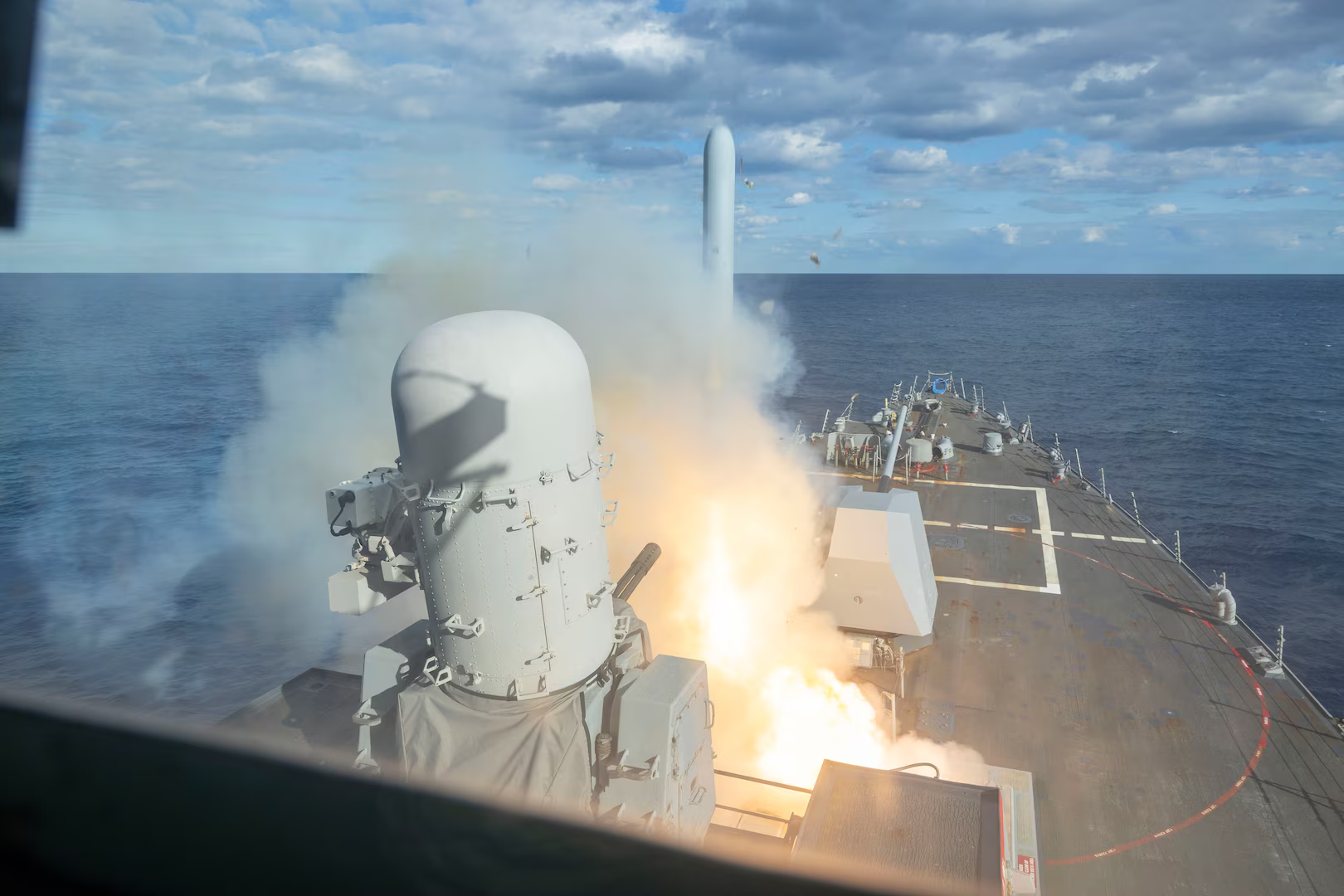
The current operation against Iran is unambiguously an air and naval campaign. The force structure deployed — carrier strike groups, fighter squadrons, bomber aircraft, cruise missiles, electronic warfare platforms — is the toolset of an air campaign. No armored divisions have been staged in Kuwait. No Marine Expeditionary Forces have been embarked. No airborne divisions have been placed on deployment alert. The logistics pipeline is moving jet fuel and precision-guided munitions, not the MREs, water, vehicle spare parts, and ammunition types associated with ground combat operations.
Why Iran Is Not Iraq
The most common frame of reference for Americans thinking about war in the Middle East is the 2003 invasion of Iraq. But Iran and Iraq are profoundly different military challenges, and anyone assuming that "we did Iraq, so we can do Iran" is operating from a fundamentally flawed analogy.
| Factor | Iraq (2003) | Iran (2026) |
|---|---|---|
| Land Area | 438,317 km² | 1,648,195 km² (3.8x larger) |
| Population | ~25 million | ~88 million (3.5x larger) |
| Terrain | Mostly flat desert/river valley | Mountainous (Zagros, Alborz) |
| Military Personnel | ~375,000 (demoralized) | ~610,000 active + 1M Basij |
| Regime Legitimacy | Low (Sunni minority rule) | Higher (nationalist sentiment) |
| National Unity | Fractured (Sunni/Shia/Kurd) | More unified against foreign invasion |
| Proxy Network | None (regional pariah) | Extensive (7+ countries) |
| Missile Capability | Limited (Scuds, most destroyed) | 3,000+ ballistic missiles in underground bunkers |
| Distance from Kuwait Border to Capital | ~550 km (Baghdad) | ~1,100 km (Tehran, from nearest approach) |
| UNSC Authorization | No (but coalition of willing) | No (Russia/China would veto) |
Iraq's military in 2003 was a hollowed-out force demoralized by a decade of sanctions, the 1991 Gulf War defeat, and a regime that promoted loyalty over competence. Iraqi units surrendered en masse, and the defense of Baghdad largely collapsed. Iran's military, while technologically inferior to the US, is a motivated, doctrinally coherent force that has spent decades preparing specifically for a US invasion. The IRGC's territorial defense doctrine assumes technological inferiority and plans accordingly — guerrilla warfare, urban resistance, dispersed operations, and asymmetric tactics designed to bleed an invading force over months and years rather than defeat it in pitched battle (Foreign Affairs, "The Folly of Attacking Iran," 2024).
Perhaps most critically, Iraq's population was deeply divided along sectarian lines. The Shia majority in southern Iraq largely welcomed the overthrow of Saddam's Sunni-dominated regime, and Kurdish forces in the north actively aided the coalition. Iran's population, while not universally supportive of the Islamic Republic's domestic policies, has a strong nationalist tradition that would likely produce unified resistance against a foreign invasion. Iranian polling, even from sources critical of the regime, consistently shows that a majority of Iranians would support armed resistance against a US ground attack — a dynamic that would transform the entire civilian population into a potential resistance force.
Terrain Analysis
Geography is the most underappreciated factor in any assessment of a ground invasion of Iran. Iran's terrain is a defender's paradise — vast, mountainous, and designed by nature to consume invading armies.
The Zagros Mountains form a 1,500-kilometer wall along Iran's western and southwestern border — precisely the direction from which any US ground force would attack. The range runs from the Turkish border in the northwest to the Strait of Hormuz in the southeast, with peaks reaching 4,409 meters (Dena peak) and passes that are narrow, easily defended, and snow-covered for months of the year. The only viable axis for large armored formations from Iraq into Iran runs through the Khuzestan lowlands in the southwest (where Iraq's Saddam Hussein invaded in 1980) — a narrow corridor that quickly rises into the Zagros foothills, channeling attackers into predictable routes where defenders can concentrate firepower.
The Alborz Mountains run along Iran's northern border, including Mount Damavand (5,609 meters, the highest peak in the Middle East). Between the Zagros and Alborz lies the Iranian Plateau — a vast, arid interior connected by a limited road network. The distance from the Iraqi border to Tehran is approximately 600-700 kilometers through mountain passes, compared to the 550 kilometers of flat terrain between Kuwait and Baghdad.
Iran's coastline along the Persian Gulf offers no better alternatives. The coastal plain is narrow — in many places only 20-50 kilometers deep before mountains begin. Any amphibious landing would face the same problem as a land invasion from the west: initial success on the coastal strip followed by an agonizing advance into mountain terrain where US technological advantages (armor, air support, logistics) are progressively degraded.
For military planners, terrain like Iran's means: slower advance rates (the US 3rd Infantry Division averaged 50-80 km/day across Iraqi desert; through Iranian mountains, 10-20 km/day would be optimistic); extended supply lines (every kilometer of mountain road is a potential ambush site); reduced effectiveness of armor (tanks are road-bound in mountains, negating their cross-country mobility advantage); and ideal conditions for guerrilla warfare (mountains provide unlimited concealment, defensive positions, and escape routes for light infantry forces). Iran's military has trained for decades in this terrain and has pre-positioned supplies, weapons caches, and command facilities throughout the mountain ranges.
Troop Requirements Estimate
Military planning for a ground campaign against Iran is not theoretical — it has been studied extensively by the US military and independent analysts. The numbers are sobering.
The standard counterinsurgency ratio, validated by decades of military experience, calls for approximately 20 security forces per 1,000 population to maintain control of occupied territory. For Iran's population of 88 million, this translates to 1,760,000 troops — more than the entire US active-duty military. Even at the more aggressive ratio used during the Iraq surge (approximately 12 per 1,000 for selected areas), Iran would require over 1 million occupation forces.
The invasion phase alone would require enormous force commitments. A RAND Corporation study from 2009, one of the most cited analyses, estimated that a ground invasion of Iran aimed at regime change would require a minimum of 500,000 troops for the initial invasion — roughly equivalent to the coalition force assembled for Operation Desert Storm in 1991 but facing a far more challenging adversary and terrain. This estimate assumes that the invasion force would need to:
- Secure the Khuzestan oil fields (Iran's primary revenue source and the most accessible territory from Iraq)
- Advance through the Zagros passes toward Isfahan and the central plateau
- Conduct a separate axis of advance toward Tehran from the west
- Protect flanks against IRGC guerrilla operations in the mountains
- Maintain supply lines back to Kuwait across hundreds of kilometers of potentially hostile territory
- Simultaneously defend against Iranian missile strikes on staging bases and supply depots
The current US Army has approximately 485,000 active-duty soldiers — fewer than the minimum estimated for the invasion phase alone, and those soldiers are distributed across global commitments including Europe (deterring Russia), the Indo-Pacific (deterring China), and domestic installations. Assembling 500,000 troops for Iran would require either stripping other theaters bare or mobilizing the National Guard and Reserve on a scale not seen since World War II, with a deployment timeline of 6-12 months for full force generation (Army War College Strategic Studies Institute, "Force Requirements for Major Theater War," 2022).
Logistics and Supply Lines
The logistical requirements of a ground campaign in Iran would be unprecedented in modern American military history. Logistics — the business of getting fuel, ammunition, food, water, spare parts, medical supplies, and replacement equipment to combat forces — is the factor that most constrains large-scale military operations, and Iran's geography makes it exceptionally challenging.
A ground force advancing from Kuwait toward Tehran would need to sustain a supply line of approximately 700-1,000 kilometers through mountain terrain with limited road infrastructure. For context, the US experienced significant supply line challenges in Iraq — a country with a relatively developed road network across flat terrain. The "Battle of the Highways" during the 2003 advance saw supply convoys attacked repeatedly by Iraqi irregulars, and the famous "wrong turn" capture of Private Jessica Lynch's 507th Maintenance Company illustrated the vulnerability of logistics units in hostile territory.
In Iran, the supply line problem is compounded by:
- Terrain: Mountain roads through the Zagros are narrow, winding, and susceptible to blockage by demolition, rockslide, or ambush. A single disabled vehicle can halt an entire supply column for hours.
- Distance: The logistics tail for a force 700+ km from its base requires intermediate supply points, fuel caches, and staging areas — all of which must be built, defended, and maintained in hostile territory.
- Iranian targeting: Iran's ballistic missile arsenal can reach rear-area supply depots, airfields, and port facilities in Kuwait and other Gulf states, potentially disrupting the entire logistics chain at its origin point.
- Climate: Extreme temperatures (exceeding 50°C in summer in Khuzestan), snow in mountain passes (rendering them impassable in winter), and limited water sources across the central plateau all complicate logistics planning.
- Scale: A 500,000-person force consumes approximately 50,000 tons of supplies per day — requiring constant truck convoys, airlift operations, and fuel pipeline construction on a scale that would take months to establish.
Special Operations vs Conventional Forces
While a conventional ground invasion is not feasible with current forces, special operations inside Iran are not only possible but almost certainly already occurring or being prepared. The distinction between "special operations" and "ground invasion" is critical and often confused in public discourse.
Special operations forces (SOF) — including Army Delta Force, Navy SEALs, Army Rangers, Air Force Special Tactics, and Marine Raiders — conduct small-unit missions that are fundamentally different from conventional warfare. These missions might include:
- Battle damage assessment (BDA): Inserting small teams to physically inspect struck nuclear sites and determine whether enrichment infrastructure was actually destroyed, particularly at underground facilities like Fordow where satellite imagery cannot assess subsurface damage.
- Intelligence collection: Recovering documents, computer systems, or nuclear material samples from struck facilities to assess the state of Iran's weapons program.
- Direct action: Raids against specific high-value targets — IRGC commanders, nuclear scientists, weapons stockpiles — that cannot be effectively targeted by air strikes alone.
- Personnel recovery: Rescuing downed aircrew or other isolated personnel behind enemy lines.
- Strategic reconnaissance: Inserting teams to provide real-time intelligence on mobile missile launchers, command posts, or other time-sensitive targets.
The US maintains the world's most capable special operations force, with approximately 70,000 total SOF personnel across all services under the United States Special Operations Command (SOCOM). JSOC (Joint Special Operations Command), the tier-one organization that includes Delta Force and SEAL Team Six, has conducted thousands of operations in Iraq, Afghanistan, Syria, and other locations. These forces can insert by helicopter, parachute, submarine, or overland infiltration, operate for days to weeks without resupply, and extract by multiple means.
The critical difference is footprint and risk. A SOF raid involves dozens to perhaps a few hundred personnel on the ground for hours to days. A ground invasion involves hundreds of thousands of personnel on the ground for months to years. The political, financial, and human costs are incomparable. SOF operations inside Iran carry risk to the individual operators but do not create the strategic commitment, occupation burden, or quagmire potential of a conventional invasion.
Afghan and Iraq Lessons Learned
The shadow of Afghanistan and Iraq hangs over every discussion of US military operations in the Middle East. These two conflicts, spanning a combined 28 years of active engagement, represent the most expensive and arguably least successful American military campaigns since Vietnam — and their lessons argue powerfully against a ground commitment in Iran.
| Factor | Afghanistan (2001-2021) | Iraq (2003-2011) | Iran (hypothetical) |
|---|---|---|---|
| Duration | 20 years | 8 years (combat) | Unknown (est. years to decades) |
| Peak Troop Deployment | 100,000 | 170,000 | Est. 500,000-1,000,000 |
| US KIA | 2,461 | 4,431 | Est. tens of thousands |
| US Wounded | 20,752 | 31,994 | Est. hundreds of thousands |
| Financial Cost | $2.3 trillion | $1.9 trillion | Est. $5-10+ trillion |
| Country Size | 652,230 km² | 438,317 km² | 1,648,195 km² |
| Population | ~30 million | ~25 million | ~88 million |
| Strategic Outcome | Taliban returned to power | Iran-aligned government | ? |
The most devastating lesson of both conflicts is that initial military success does not translate into strategic success. The US toppled the Taliban government in weeks and captured Baghdad in three weeks — military achievements that seemed to validate the theory that American technological superiority could achieve quick, decisive victories. But the subsequent occupation, counterinsurgency, and nation-building efforts consumed decades, trillions of dollars, and thousands of American lives without achieving durable strategic objectives. Afghanistan returned to Taliban control within months of US withdrawal. Iraq became a government aligned with Iran — the very country the US was trying to contain.
Iran would present these challenges at massively greater scale. A country 3-4 times larger than either Afghanistan or Iraq, with a population more than triple either, with more difficult terrain, a more capable military, a more sophisticated political system, and a proxy network capable of attacking US interests across the entire region. The RAND Corporation's assessment is blunt: "An occupation of Iran would likely require a commitment of resources and personnel that would dwarf the Iraq and Afghanistan campaigns combined, with no assurance of a better outcome" (RAND Corporation, "Consequences of a Military Confrontation with Iran," 2023).
Pentagon Planning Constraints
Beyond the operational arguments against a ground invasion, the Pentagon faces institutional constraints that make large-scale ground operations extremely difficult to execute even if ordered.
The US military has been structured since the end of the Cold War for two simultaneous regional conflicts — but at force levels far below what a single Iran invasion would require. The 2022 National Defense Strategy shifted the primary focus to great power competition with China and Russia, meaning that significant military resources — including carrier strike groups, fighter squadrons, Army divisions, and intelligence assets — are committed to the Indo-Pacific and European theaters. Pulling forces from these theaters for Iran operations would create vulnerabilities that adversaries could exploit.
The Army's active-duty end strength of approximately 485,000 soldiers is the lowest since before World War II. The service has struggled with recruitment, missing its targets by 15,000-25,000 soldiers in recent fiscal years. The National Guard and Reserve provide additional capacity, but mobilizing and deploying these forces takes months and disrupts civilian communities. There is no realistic path to assembling 500,000 ground troops for Iran operations without either a presidential mobilization order (calling up the entire reserve component) or conscription — a political impossibility in the current environment.
The precision-guided munitions supply is another constraint. Modern air campaigns consume enormous quantities of expensive weapons. During the 2011 Libya operation, European allies ran low on precision munitions within weeks. The US has deeper stocks, but a sustained campaign against Iran — a country with far more targets than Libya, Iraq, or any previous adversary — would stress even American production capacity. The defense industrial base requires months to years to surge production of systems like JASSM-ER ($1.3 million each), JDAM kits ($25,000 each), and Tomahawk missiles ($1.5 million each). A ground campaign would add demand for ground-combat munitions (artillery rounds, anti-tank missiles, small arms ammunition) on top of air-campaign expenditures.
Political Feasibility
The most insurmountable obstacle to a ground invasion of Iran may not be military but political. The War Powers Resolution requires Congressional authorization for sustained military operations beyond 60 days. While presidents have historically stretched the interpretation of this requirement (the Obama administration argued that the Libya air campaign did not constitute "hostilities"), deploying hundreds of thousands of ground troops would unambiguously require Congressional approval — approval that does not exist.
The current Congress is deeply divided on Iran policy. The administration's authority for Operation Epic Fury rests on a combination of Article II commander-in-chief powers (self-defense against Iranian attacks on US bases), the 2001 Authorization for Use of Military Force (AUMF, stretched beyond its original intent), and the argument that limited strikes do not require new authorization. A ground invasion would collapse this legal framework instantly. Congressional leaders from both parties have explicitly stated that a ground war in Iran would require separate authorization, and there is no indication that such authorization would pass either chamber.
Public opinion data reinforces the political impossibility. Polling conducted before the current strikes showed 65-70% of Americans opposed to sending ground troops to Iran, with opposition crossing partisan lines. Support for air strikes was significantly higher (~45-55% in favor), confirming that the American public distinguishes between air operations and ground combat in their assessment of acceptable risk. The memory of Iraq and Afghanistan remains vivid for the voting public, and no politician seeking re-election — including the President — wants to own a ground war in a country that makes Iraq look simple by comparison (Foreign Affairs, "American Public Opinion and the Iran Question," 2025).
What Happens Instead
If a ground invasion is off the table, what does the US strategy for Iran actually look like? The answer is a combination of sustained air and naval operations, special operations, economic warfare, and deterrence that aims to achieve maximum strategic effect with minimum American casualties and political exposure.
The current campaign follows a model closer to Operation Allied Force (Kosovo, 1999) than Operation Iraqi Freedom. In Kosovo, NATO conducted a 78-day air campaign against Serbia without deploying ground troops, ultimately achieving its objective (Serbian withdrawal from Kosovo) through air power, diplomatic pressure, and the threat of ground action. The Iran campaign appears designed along similar lines: sustained air strikes to destroy nuclear infrastructure, degrade military capability, and impose sufficient costs that Iran's leadership calculates continued resistance is more dangerous than accommodation.
The specific elements of this strategy include:
- Continued air and missile strikes against remaining military targets, expanding to infrastructure that supports Iran's nuclear program, IRGC operations, and ballistic missile production.
- Naval blockade or maritime interdiction to prevent Iranian oil exports and weapons shipments to proxy groups, economically strangling the regime.
- Cyber operations against Iranian military command and control, financial systems, and potentially civilian infrastructure (power grid, communications) to increase domestic pressure on the government.
- Special operations raids for specific high-value missions — nuclear site assessment, intelligence collection, targeting of key military leaders.
- Maximum economic sanctions to prevent post-conflict reconstruction of military capability and maintain long-term pressure on the regime.
- Diplomatic engagement through intermediaries (potentially Oman, which has historically mediated between the US and Iran) to find an off-ramp that achieves US objectives without requiring occupation.
This strategy has limitations. Air power alone cannot verify the destruction of underground nuclear facilities, cannot secure nuclear material, and cannot guarantee that Iran will not reconstitute its programs over time. But the alternative — a ground invasion and occupation — carries costs so enormous and outcomes so uncertain that it fails every reasonable cost-benefit analysis. The lesson of the past two decades is that the United States is very good at destroying things from the air and very bad at building nations on the ground. The Iran strategy appears designed around that asymmetry.
Related Coverage
- Iran vs US Military Comparison 2026: Strength, Numbers, and Key Asymmetries
- US Military Buildup Near Iran: Where American Forces Are Positioned
- Operation Epic Fury Explained: Targets, Strategy, and What Comes Next
- US Military Begins 'Major Combat Operations in Iran,' Trump Says
- War Powers Resolution and Iran Strikes: Where Congress Stands
Research Hubs
- Iran-Israel-Dubai War Guide
- Iran Nuclear and Military Briefing
- Israel Security and Escalation Briefing
- Dubai and UAE Risk Briefing
- Source Center: Primary References
Sources
- RAND Corporation, "Military Operations Against Iran: Feasibility, Requirements, and Consequences," 2023 updated assessment. rand.org
- War on the Rocks, "Parsing the Language of Iran Operations: What 'Major Combat Operations' Means and Doesn't Mean," February 28, 2026. warontherocks.com
- Foreign Affairs, "The Folly of Attacking Iran: Why a Ground Campaign Would Be America's Worst Strategic Mistake," November 2024. foreignaffairs.com
- Center for Strategic and International Studies (CSIS), "Iran Contingency Planning: Force Requirements and Strategic Options," January 2026. csis.org
- US Army War College, Strategic Studies Institute, "Force Requirements for Major Theater War in Mountainous Terrain: Lessons for Iran Planning," 2022. ssi.armywarcollege.edu