What Happened: Overview
U.S. military begins "major combat operations in Iran," Trump says described the opening of a very large coordinated strike campaign on February 28, 2026. Named reporting from NBC News, CBS News, Reuters, and others consistently supported the fact of the operation, the public framing from Washington, and the immediate regional consequences.
The strongest public record supports three points: the operation happened, it was much larger than earlier strike cycles, and it quickly triggered retaliation and regional emergency measures. The weaker part of the early reporting involved the most exact target and casualty claims, which this revision treats more cautiously.
Trump's Announcement and Key Quotes
President Trump framed the strikes as a defensive necessity, stating that Iran could "never have a nuclear weapon" and describing the operation as eliminating "imminent threats." In his televised address, Trump declared: "All I want is freedom for the people. I want a safe nation, and that's what we're going to have." (CBS News)
Trump referenced Iran's 1979 embassy hostage crisis, in which 52 American diplomats were held for 444 days, framing the current operation as part of a long arc of American confrontation with Tehran. He also blamed Iran's proxy Hamas for the October 7 attacks on Israel, drawing a direct line from Iran's regional influence network to the justification for military action. (NBC News)
The president acknowledged the possibility of American casualties, a notable departure from previous statements that had emphasized the precision and limited risk of US operations against Iran. Trump stated that Iran would "soon" possess intercontinental ballistic missiles capable of reaching the United States, though NBC News noted that the Defense Intelligence Agency's own assessment placed that timeline at 2035 if Iran pursued such a program. (NBC News)
Netanyahu's Statement
Israeli Prime Minister Benjamin Netanyahu described the joint operation in terms that went beyond nuclear containment, stating that the strikes would "create conditions for the courageous Iranian people to take their destiny into their own hands." This language was widely interpreted as signaling regime change objectives, a framing that drew immediate criticism from congressional opponents who argued the operation exceeded its stated mandate. (NBC News)
Operation Epic Fury and The Roar of the Lion
Named reporting described a coordinated division of labor between the U.S. and Israeli sides of the operation. The clearest conclusion is that the campaign combined a U.S. focus on broader military and nuclear-linked infrastructure with Israeli emphasis on leadership and high-value command targets.
What is less certain in the public record is the exact extent to which every cited leader or site was successfully struck in the first wave. This page now keeps the broad operational design in the foreground without treating every early detail as equally confirmed.
Targets Hit Across Iran
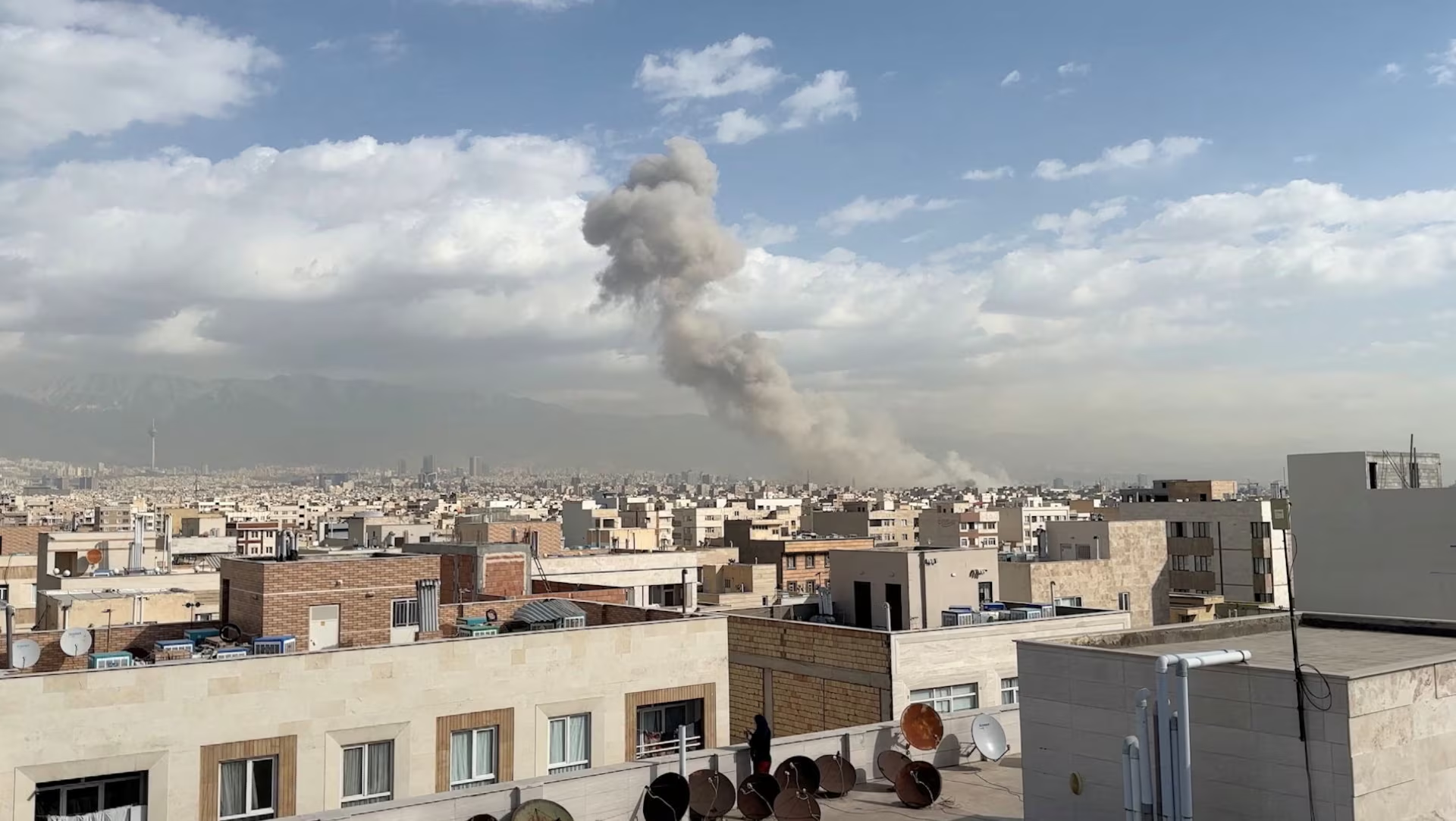
Al Jazeera reported multiple explosions heard in downtown Tehran, with smoke visible rising from various locations across the capital. Blasts were also reported across several other cities throughout the country, indicating a geographically dispersed strike campaign rather than a concentrated attack on a single target set. (Al Jazeera)
US Target Set: Missiles and Nuclear Infrastructure
The American strikes focused on two categories of targets. First, Iran's ballistic missile program infrastructure, including production facilities, storage sites, and launch platforms associated with the country's arsenal of "high hundreds to low thousands" of missiles. Second, nuclear program facilities, continuing the campaign begun during Operation Midnight Hammer in June 2025 to degrade Iran's nuclear enrichment and weapons development capabilities. (CBS News)
Israeli Target Set: Leadership Decapitation
Israel's strikes pursued a more politically ambitious objective: targeting Iran's senior leadership. Both Supreme Leader Ayatollah Ali Khamenei and President Masoud Pezeshkian were among the initial strike targets. Iranian state media quickly asserted that both leaders were "safe and sound" following the attacks, though independent verification of their status was not immediately possible given the near-total internet blackout inside Iran. (CBS News, Al Jazeera)
The decision to target political leadership rather than exclusively military infrastructure marked a significant escalation beyond previous operations and aligned with Netanyahu's stated goal of creating conditions for the Iranian people to "take their destiny into their own hands."
Iranian Retaliation: Missiles at US Bases
Iran's armed forces launched retaliatory strikes within hours of the initial US-Israeli attack, targeting American military installations across the Persian Gulf in what represented the most significant direct attack on US forces since the 2020 Ain al-Asad strike in Iraq. Iran's Supreme National Security Council promised a "crushing response" to the attacks, while the Foreign Ministry declared that "the armed forces of the Islamic Republic of Iran will respond to the aggressors with authority." (NBC News, CBS News)
US Bases Targeted
Iran launched ballistic missiles at multiple US military facilities across the region:
- Al Udeid Air Base, Qatar — the largest US air base in the Middle East, home to the Combined Air Operations Center that coordinates all US air operations in the region
- Al Salem Air Base, Kuwait — a key logistics and staging hub for US operations in the Persian Gulf
- Al Dhafra Air Base, UAE — home to US Air Force fighter and reconnaissance aircraft
- US Fifth Fleet Headquarters, Bahrain — the command center for US naval operations across the Persian Gulf, Arabian Sea, and Red Sea
- US facilities in Jordan — additional military installations targeted in the broader retaliatory campaign
(NBC News)
Additional Retaliatory Actions
Beyond the strikes on US bases, Iran's Revolutionary Guards launched retaliatory missile and drone strikes toward Israel. Al Jazeera reported that a missile was intercepted in Qatar, and an explosion was reported in Abu Dhabi, UAE. Bahrain reported a missile attack specifically targeting the US Navy's Fifth Fleet headquarters. (Al Jazeera)
Multiple Gulf nations activated their air defense systems and intercepted Iranian missiles. The geographic spread of the retaliation, spanning at least five countries, underscored the regional nature of the conflict and the exposure of US forces stationed throughout the Persian Gulf.
Casualties and Damage Assessment
Initial casualty and damage reporting remained limited and uneven. Named reporting described impacts, emergency measures, and early casualties, but internet disruptions, wartime restrictions, and the speed of the operation meant the full picture was not settled in the first reporting cycle.
This page therefore keeps the fact of casualties and damage in the foreground while being more careful about exact totals, exact facility status, and the broader implications of every early report.
Congressional Reaction: Bipartisan Split
The announcement that the U.S. military had begun major combat operations in Iran triggered an immediate and deeply divided response in Congress, cutting across traditional party lines in ways that reflected the complexity of the political moment.
Opposition
Republican Representative Thomas Massie of Kentucky condemned the strikes as unauthorized by Congress, arguing that the president had exceeded his constitutional authority by launching what amounted to a war without legislative approval. The War Powers Resolution requires the president to notify Congress within 48 hours of committing armed forces to military action and sets a 60-day limit on deployments without congressional authorization. (NBC News)
Democratic Senator Ruben Gallego of Arizona offered one of the sharpest critiques, warning: "Young working-class kids should not pay the ultimate price for regime change." His statement directly challenged Netanyahu's framing of the operation as creating conditions for the Iranian people to overthrow their government, identifying the gap between stated objectives and the human cost of achieving them. (CBS News)
Support
Senator John Fetterman of Pennsylvania, a Democrat, expressed support for the strikes, continuing his consistent backing of military action against Iran. Republican Senator Lindsey Graham of South Carolina called the operation "necessary and long justified," framing it as a response to decades of Iranian aggression and proxy warfare. (NBC News, CBS News)
The bipartisan split, with opposition from both a libertarian-leaning Republican (Massie) and a progressive Democrat (Gallego), alongside support from both a centrist Democrat (Fetterman) and a hawkish Republican (Graham), defied simple partisan categorization and reflected the genuine ideological divisions the Iran question creates within both parties.
International Response
International reaction to the strikes reflected the global stakes of the operation, with key allies offering qualified support while the broader international community expressed alarm at the escalation.
Australia's Prime Minister expressed support for the strikes, framing them as necessary to prevent Iran from developing nuclear weapons. The Australian government's backing aligned Canberra with the US-Israeli position and represented one of the few explicit endorsements from a Western ally in the immediate aftermath. (CBS News)
Airspace Closures and Aviation Disruption
Multiple countries across the region closed their airspace in response to the strikes and Iranian retaliation. Iranian, Israeli, and Iraqi airspace were all shut down to civilian traffic. Major airlines canceled regional flights as missile trajectories crossed commercial aviation corridors. The FAA issued NOTAMs (Notices to Air Missions) restricting US carrier flights in affected airspace. (Al Jazeera, CBS News)
Embassy Alerts
Multiple US embassies across the Middle East issued shelter-in-place orders for American citizens in the region, reflecting the geographic breadth of the conflict zone and the retaliatory missile strikes reaching across the Persian Gulf. The US Embassy in Jerusalem issued specific shelter-in-place instructions as Israel braced for Iranian missile and drone attacks. (CBS News)

Diplomatic Context: Israel Preempted Diplomacy
Perhaps the most consequential revelation in the initial reporting came from a Middle East diplomat who told NBC News that Israel had "intervened to preempt diplomacy" at a moment when negotiations between the US and Iran appeared close to producing results. This claim, if accurate, suggests that the military operation was launched not because diplomacy had failed but because it was on the verge of succeeding in ways that Israel found unacceptable. (NBC News)
The diplomatic preemption claim carries enormous implications. It suggests a fundamental divergence between US diplomatic objectives, which at least nominally included a negotiated resolution to the nuclear standoff, and Israeli strategic objectives, which have consistently favored military action over diplomatic accommodation. If Israel accelerated the timeline for strikes specifically to prevent a diplomatic breakthrough, it would represent one of the most consequential acts of allied influence on American foreign policy in modern history.
The Oman channel, which had served as a backchannel for US-Iran negotiations for over two decades, appeared to have been the venue for the negotiations that the diplomat referenced. Whether the Trump administration was a willing participant in the diplomatic sabotage or was presented with a fait accompli by Israeli action remains an open question that will likely be the subject of congressional inquiry.
Historical Context: From Midnight Hammer to Epic Fury
Operation Epic Fury represents the second major US military campaign against Iran within eight months, following Operation Midnight Hammer in June 2025. The escalation from a targeted strike campaign to what the president himself called "major combat operations" traces a trajectory that many analysts had warned was inevitable once the initial military threshold was crossed.
Operation Midnight Hammer (June 2025)
The June 2025 strikes targeted Iranian nuclear facilities following the collapse of diplomatic negotiations and Iran's acceleration of uranium enrichment activities. While that operation caused significant damage to above-ground nuclear infrastructure, it failed to eliminate Iran's enrichment capability, particularly at the deeply buried Fordow facility. Iran's retaliatory missile salvo against Al Udeid Air Base in the aftermath demonstrated both the limits of preemptive strikes and the escalatory risks of military action. (NBC News)
Trump's Historical References
In his announcement of Epic Fury, Trump drew direct historical lines from the 1979 Iranian hostage crisis, during which 52 American diplomats were held captive for 444 days following the Islamic Revolution, to the current operation. He also cited Hamas's October 7, 2023 attacks on Israel, attributing them to Iranian support for the Palestinian militant group as part of Tehran's network of regional proxies. These references served to frame the strikes not as a new conflict but as the culmination of decades of unresolved confrontation between the United States and the Islamic Republic. (NBC News)
Escalation Pattern
The progression from Midnight Hammer's targeted strike package to Epic Fury's "major combat operations" followed a pattern that defense analysts had identified as a key risk: each military exchange raised the baseline for the next round. Iran's retaliatory capabilities, far from being degraded by the June 2025 strikes, appeared to have been maintained or even expanded, as evidenced by the scale and geographic reach of the February 2026 counter-strikes across five countries.
Internet Blackout and Emergency Measures
Internet connectivity inside Iran collapsed to approximately 4% of normal levels, according to data from Netblocks, the internet monitoring organization. The near-total blackout, whether caused by infrastructure damage from strikes or deliberate government shutdown, effectively cut off 88 million Iranians from the outside world and made independent reporting on conditions inside the country nearly impossible. (NBC News)
Emergency Measures
The Iranian government ordered the closure of schools and universities across the country, while notably keeping banks open in an apparent effort to signal economic stability and prevent financial panic. The decision to maintain banking operations during an active military campaign represented an unusual wartime calculation, prioritizing economic continuity over civilian shelter. (NBC News)
Israel declared a nationwide state of emergency, closing its airspace to all civilian flights and activating its multi-layered missile defense network. The US Embassy in Jerusalem issued shelter-in-place orders for all American citizens. Gulf states that hosted US military bases, now direct targets of Iranian retaliation, activated their own emergency protocols as missiles struck or were intercepted over their territory. (Al Jazeera)
What Can Be Verified So Far
This page is strongest when it separates direct reporting from inference.
- Directly supported: Trump publicly described the operation as major combat operations, named reporting described a large joint strike campaign, and Iran retaliated across the region.
- Supported but still fluid: exact target totals, exact senior-leadership casualty counts, and the full damage and casualty picture across Iran and the Gulf.
- More interpretive than proven: claims that the long-term strategic effect of the first strikes was already settled or that every dramatic first-wave detail was equally confirmed.
What Happens Next
The announcement that the U.S. military has begun major combat operations in Iran sets in motion a chain of events whose outcome remains deeply uncertain. Based on the available evidence and historical precedent, several scenarios and key variables will shape the days and weeks ahead.
Congressional War Powers
Under the War Powers Resolution, the president must notify Congress within 48 hours and has a 60-day window before requiring legislative authorization to continue operations. Given the bipartisan opposition already voiced by figures like Rep. Massie and Sen. Gallego, a war powers vote is likely, though the political dynamics in both chambers make the outcome difficult to predict. A detailed analysis of the War Powers timeline is available.
Iranian Escalation Options
Iran retains significant retaliatory capabilities beyond the initial missile strikes. These include potential closure or mining of the Strait of Hormuz, activation of regional proxy networks (Hezbollah, Houthis, Iraqi militias), cyber operations against US critical infrastructure, and further missile salvos against US bases and Israeli territory. The scale of the initial Iranian retaliation across five countries suggests Tehran is willing to absorb significant risk to demonstrate deterrent capability.
Nuclear Breakout Risk
One of the most consequential unknowns is whether the strikes will delay or accelerate Iran's path to a nuclear weapon. With IAEA access already severely limited, the international community has reduced visibility into Iran's nuclear activities. If Iran's parliament follows through on draft legislation to withdraw from the Non-Proliferation Treaty, the last international oversight mechanisms would be removed.
Variables to Watch
- Whether the "major combat operations" designation leads to sustained military campaign or limited strikes followed by off-ramp negotiations
- The scale and duration of Iranian retaliatory operations beyond the initial salvo
- Oil price movements and potential Strait of Hormuz disruption
- Congressional action on War Powers Resolution
- Status of Iranian leadership (Khamenei, Pezeshkian) as independent reporting becomes possible
- Activation of Hezbollah, Houthi, or Iraqi militia proxy networks
Related Coverage
- US Strikes Iran: Full Timeline, Targets, and Global Impact
- US and Israel Launch Strikes on Iran: Operation Shield of Judah
- Iran Response to US Strikes: Missiles, Diplomacy, and What Comes Next
- Iran Retaliates Against US Bases: Which Facilities Were Targeted
- War Powers and Iran Strikes: What Congress Can Do, and On What Timeline
- Operation Midnight Hammer: What the Public Record Says About Damage and Limits
Research Hubs
- Iran-Israel-Dubai War Guide
- Iran Nuclear and Military Briefing
- Israel Security and Escalation Briefing
- Dubai and UAE Risk Briefing
- Source Center: Primary References
Sources
- International Atomic Energy Agency, Iran focus page. iaea.org
- UN Security Council updates and official records. un.org/securitycouncil
- UN Charter full text (Article 51 legal context). un.org
- U.S. Department of Defense official releases. defense.gov
- U.S. Department of State, Iran country page. state.gov
- UAE Ministry of Foreign Affairs media hub. mofa.gov.ae
- OFAC Iran sanctions framework. ofac.treasury.gov
- CISA advisory on Iran-linked cyber activity. cisa.gov
- EIA world oil transit chokepoints. eia.gov
- MARAD maritime security advisories. maritime.dot.gov
- Council on Foreign Relations analysis archive on Iran conflict and nuclear risk. cfr.org
- Center for Strategic and International Studies, Iran and regional security analysis. csis.org
- Reuters and AP Middle East coverage trackers. reuters.com; apnews.com