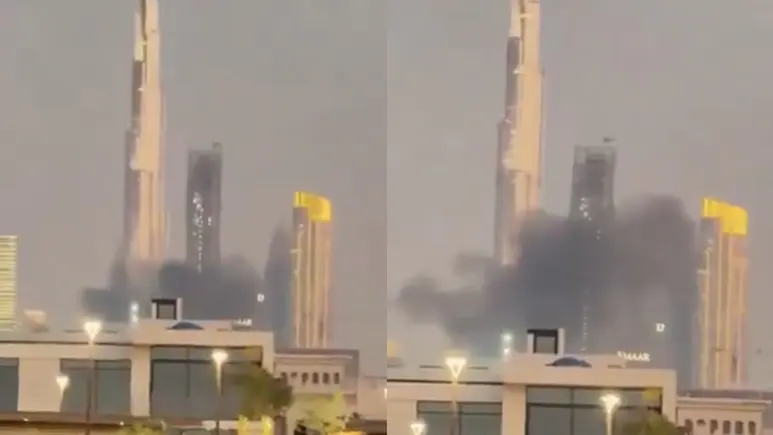
On February 28, 2026, Dubai's iconic Burj Khalifa was evacuated after multiple explosions rocked the city during Iran's retaliatory missile strikes on Gulf states, part of what Tehran called Operation True Promise 4. While UAE air defenses intercepted most incoming Iranian ballistic missiles, debris struck civilian areas including a luxury Palm Jumeirah hotel, killing one person in Abu Dhabi and prompting a full suspension of flights across the region.
Overview
Dubai's Burj Khalifa hit by Iran missile? That question dominated social media and search engines worldwide on the afternoon of February 28, 2026, after viral video footage appeared to show an explosion near the world's tallest building. The 828-meter tower — a symbol of Gulf prosperity and modernity — was at the center of a rapidly escalating crisis as Iran launched retaliatory missile strikes against US military installations across the Persian Gulf, striking the UAE, Qatar, Kuwait, and Bahrain simultaneously.
The strikes came hours after the United States and Israel launched joint military operations against Iran. President Trump had earlier declared the beginning of "major combat operations" in Iran, and Iran's Islamic Revolutionary Guard Corps (IRGC) responded by targeting American military assets across the region. The UAE, which hosts Al-Dhafra Air Base — a critical node in America's Middle East force posture — found itself directly in the crosshairs. While UAE authorities have not confirmed that the Burj Khalifa was directly struck, the evacuation of the world's tallest building during an active missile barrage sent shockwaves far beyond the Gulf, as reported by NDTV, Bloomberg, and numerous other international outlets.
What Happened Near the Burj Khalifa
Timeline of Events
The sequence of events unfolded rapidly on Saturday afternoon. After US-Israeli strikes began hitting targets inside Iran earlier that day, the IRGC announced it was launching retaliatory operations against American military positions across the Gulf. Within hours, the consequences reached Dubai's doorstep.
Residents of the Greens Community — a residential neighborhood near Dubai Marina and the Palm Jumeirah — reported hearing at least six distinct explosions, according to Dubai Eye 103.8. The blasts were audible across wide swaths of the city, from the beaches of Jumeirah to the high-rises of Downtown Dubai where the Burj Khalifa stands.
Emergency protocols were activated almost immediately. Sirens sounded across parts of the city, and security teams moved to evacuate the Burj Khalifa, clearing visitors from the observation decks on the 124th, 125th, and 148th floors. Police cordoned off surrounding streets in Downtown Dubai while investigations continued, according to Sunday Guardian Live. The tower, which attracts millions of visitors annually, was fully emptied as a precautionary measure.
Was the Burj Khalifa Actually Hit?
Despite the dramatic footage circulating online, UAE officials have not confirmed any direct damage to the Burj Khalifa. According to the Sunday Guardian Live, "officials have not confirmed direct damage to the tower." Initial reports suggested that Iranian missile trajectories aligned with zones containing US defense facilities rather than civilian landmarks. The evacuation was precautionary — a standard emergency response given the proximity of explosions and the building's status as a high-profile target.
That said, the fact that multiple explosions were audible from Downtown Dubai, and that video footage showed flashes and plumes of smoke in the general vicinity of the tower, made the situation feel anything but routine for the thousands of residents and tourists in the area.
The Viral Videos and Social Media Reaction
Within minutes of the first explosions, videos began flooding social media platforms. NDTV posted footage on X (formerly Twitter) with the caption questioning whether Dubai's Burj Khalifa had been hit by an Iran missile, showing what appeared to be an explosion near the world's tallest building. The video racked up millions of views within the first hour.
Oneindia reported on a separate "chilling video" that appeared to show Iran's Shahed drones near the Burj Khalifa, describing it as footage that "shocks internet." Bloomberg published video of a missile striking a Dubai hotel after the US-Israeli attack on Iran, further fueling the sense of a city under siege.
On Reddit, threads in r/worldnews and r/dubai lit up with eyewitness accounts, shared videos, and heated debates about the implications of Iran targeting civilian infrastructure in the Gulf. Users posted footage from apartment balconies showing flashes on the horizon and the sound of air defense systems engaging incoming projectiles. The discussion threads quickly became central information hubs, with users fact-checking claims in real time — distinguishing between intercepted missiles, debris falls, and actual impacts.
The confusion was understandable. In the fog of a multi-front missile barrage, distinguishing between an interception overhead and an impact on the ground is nearly impossible from ground-level smartphone footage. Many of the early "Burj Khalifa hit" claims appear to have been based on intercepted missiles or debris falls rather than direct strikes on the tower itself.
Iran's Operation True Promise 4 — Why Dubai Was Hit
Iran framed its retaliatory strikes as "Operation True Promise 4," the fourth iteration of Iran's missile response campaigns following escalating tensions with the US and Israel. According to Iran's Fars news agency, the IRGC simultaneously targeted multiple US military installations across the Gulf:
- Al-Dhafra Air Base (Abu Dhabi, UAE) — a major hub for US Air Force operations in the Middle East
- Al-Udeid Air Base (Doha, Qatar) — the forward headquarters of US Central Command
- Ali Al Salem Air Base (Kuwait) — a logistics and staging area for US forces
- US Fifth Fleet Naval Base (Juffair, Bahrain) — headquarters of the US Navy's Fifth Fleet
The strikes came in direct retaliation for joint US-Israeli operations against Iran earlier that Saturday. President Trump had characterized the action as the beginning of "major combat operations," while Israel's defense minister confirmed Israeli participation in strikes on Iranian defense systems. Iran's Foreign Ministry declared that "the time has come to defend the homeland and confront the enemy's military encroachment," according to India TV News.
Dubai itself was not a declared military target. The UAE hosts US military assets under existing defense agreements, and it was these installations — particularly Al-Dhafra — that Iran aimed at. However, ballistic missiles and their debris do not discriminate between military and civilian zones, and the geographic proximity of US bases to dense urban areas in the Gulf meant that civilian impact was virtually inevitable. According to The Week, the Fairmont hotel strike occurred during what was described as Iran's third wave of attacks.
UAE Air Defense Response
The UAE Ministry of Defence moved quickly to address the incoming threat. In an official statement, the Ministry confirmed that the country had faced "a blatant attack involving Iranian ballistic missiles" and that UAE air defense systems "successfully intercepted a number of missiles," as reported by Gulf News.
The interceptions were largely successful. Multiple Iranian ballistic missiles were destroyed before reaching their intended targets. However, the nature of missile defense means that even successful interceptions produce falling debris — and it was this debris that caused the civilian casualties.
According to the Khaleej Times, the UAE's National Emergency Crisis and Disasters Management Authority (NCEMA) confirmed the "situation is under control" and that "monitoring is maintained around the clock." The Ministry stated that air defenses "demonstrated high efficiency in responding to the attack."
A second wave of Iranian missiles was subsequently intercepted with no additional injuries reported, suggesting the UAE's layered defense systems held under sustained pressure.
NCEMA Safety Warnings
In the aftermath of the interceptions, NCEMA issued urgent guidance to the public, as detailed by Gulf News:
- Stay away from shrapnel and suspicious objects
- Do not touch or photograph debris
- Allow authorities to handle all necessary procedures
- Rely only on official sources for information
Abu Dhabi residents received emergency alerts on their phones warning of "potential missile threats" and advising them to shelter away from windows and open areas.
Damage Across Dubai and the Gulf
Fairmont The Palm Hotel Fire
The most visible damage in Dubai occurred at the five-star Fairmont The Palm hotel on Palm Jumeirah. According to The Week, the hotel was "reportedly hit by debris from a missile intercepted by the UAE's defences," though alternative reports suggested it may have been struck by one of Iran's Shahed kamikaze drones that penetrated the defense net. Bloomberg described the scene as "black smoke rising out of the city-state's most celebrated neighborhood," with "four people injured in a fire at Palm Jumeirah."
Visuals shared widely on social media showed thick plumes of smoke billowing from the hotel as firefighting crews worked to bring the blaze under control.
Abu Dhabi Casualties
The single confirmed fatality in the UAE occurred in Abu Dhabi. According to Al Arabiya and India TV News, debris from an intercepted missile fell on a residential area in the capital, killing a civilian identified as being of Pakistani nationality. Material damage was also reported in surrounding residential zones.
Wider Gulf Impact
The strikes were not limited to the UAE. Al Jazeera reported that the US-Israeli strikes on Iran had killed 201 people, with Iran firing back and causing blasts across the region. Qatar intercepted two incoming missiles, with CNN footage showing projectiles being intercepted above the West Bay skyline in Doha. Bahrain confirmed that its territory — and specifically the US Fifth Fleet base in Juffair — had been targeted. Explosions were also reported in Kuwait and Saudi Arabia's capital Riyadh, according to India TV News.
Economic and Aviation Fallout
Bloomberg characterized the events as "Dubai's Worst Nightmare", writing that "defense systems repelling Iranian missiles and drones over its famous skyscrapers, random explosions and plumes of black smoke rising out of the city-state's most celebrated neighborhood" represented the scenario Gulf leaders had long feared but hoped would never materialize.
Aviation Shutdown
All flights to and from Dubai airports were immediately suspended. Emirates, Etihad Airways, Qatar Airways, and other regional carriers halted operations entirely, as reported by India TV News. Gulf airspace closures forced cancellations and reroutes for carriers worldwide. Dubai International Airport, the world's busiest for international passenger traffic, went dark — an unprecedented event in the airport's history. Bloomberg reported that "civil air traffic began to clear out within hours of Iran's retaliatory strikes on US bases."
Financial Markets
Dubai and Abu Dhabi have spent decades building themselves into global financial centers, built — as Bloomberg noted — "on a bedrock of safety, stability and proximity to deep pools of capital." Iran's attacks came as a jarring reminder of geography. Energy prices showed immediate volatility, and analysts warned that sustained escalation could disrupt shipping lanes near the Strait of Hormuz, threatening global oil exports. Tourism — a pillar of Dubai's economy — faced an overnight existential question: can a city under missile fire maintain its brand as a safe haven for international business and leisure?
What Officials Have Said
UAE Government
The UAE Ministry of Defence strongly condemned the attack, describing it as a "blatant violation of national sovereignty and International Law" and a "dangerous escalation" constituting a "cowardly act" threatening civilian safety and regional stability, according to Gulf News. The UAE stated it "reserves full right to take all necessary measures to protect its territory and people."
NCEMA confirmed the "situation is under control" with "monitoring maintained around the clock," urging citizens and residents to rely on official sources and avoid spreading unverified information, per the Khaleej Times.
Iran's Position
Iran's Islamic Revolutionary Guard Corps claimed responsibility for the strikes, framing them as targeting US military assets rather than Gulf civilian infrastructure. Iran's Foreign Ministry declared the strikes were defensive, stating that "the time has come to defend the homeland and confront the enemy's military encroachment." The IRGC specifically named Al-Dhafra Air Base in the UAE, Al-Udeid in Qatar, and the Fifth Fleet in Bahrain as intended targets, per Iran International.
Regional and International Response
Saudi and UAE leaders broke ice to discuss the security situation following the strikes, according to Bloomberg. The broader international community watched with alarm as the conflict's footprint expanded well beyond Iran and Israel to engulf the entire Persian Gulf region.
What's Next
The situation remains fluid and deeply uncertain. Several key developments bear watching:
- UAE's response: The UAE explicitly reserved its "full right to respond" to the Iranian strikes. Whether Abu Dhabi pursues a diplomatic or military response — or joins the US-Israeli coalition more formally — will shape the next phase of the conflict.
- Further Iranian strikes: If US and Israeli operations against Iran continue, Tehran has demonstrated the willingness and capability to strike across the Gulf. The question is whether future waves target the same installations or expand to new targets.
- Dubai's recovery: The speed at which Dubai can restore flights, reassure investors, and resume normal operations will be a key indicator of the emirate's resilience and the conflict's lasting economic impact.
- Strait of Hormuz: If Iran moves to restrict shipping through the Strait — through which roughly 20% of the world's oil passes — the economic fallout would dwarf the immediate damage from the missile strikes. CNBC reported on the global implications of the retaliatory strikes.
- Civilian protection: The killing of a Pakistani national in Abu Dhabi and injuries at the Fairmont hotel raise urgent questions about civilian exposure in Gulf cities that double as host nations for US military facilities.
Why It Matters
The evacuation of the Burj Khalifa during an active Iranian missile barrage is without modern precedent. Dubai's entire brand — as a tourist destination, financial hub, and safe haven — rests on the perception that the Gulf states sit outside the conflict zones that define much of the broader Middle East. Saturday's events shattered that perception, however temporarily.
As France 24 reported, residents fled as "Iran missiles stun peaceful Gulf cities." The psychological impact alone — air raid sirens in Dubai, the world's tallest building emptied, luxury hotels burning on the Palm — will resonate in corporate boardrooms and tourism ministries for years to come.
For the hundreds of thousands of expatriates living in the UAE, the strikes represented a terrifying new reality: the proximity of US military bases to civilian population centers means that any escalation between Iran and the United States puts Gulf residents directly in harm's way, even when they are not the intended target.
Related Coverage
- Iran Retaliates: US Bases Targeted Across the Gulf
- Gulf States Response to Iran Attacks
- Iran Strikes Back: Where and What Was Hit
- Iran Strikes Tonight: What Officials Have Confirmed
- U.S. Military Begins 'Major Combat Operations in Iran,' Trump Says
- Regional Missile Defense Systems: Middle East Explainer
Sources
- NDTV. "Dubai's Burj Khalifa Hit By Iran Missile? Video Shows Explosion Near World's Tallest Building." ndtv.com
- Bloomberg. "Dubai's Worst Nightmare Unfolds as Iran Strikes Gulf Neighbors." bloomberg.com
- Bloomberg. "Iran Strikes: Explosions in Dubai, Abu Dhabi Jolt Middle East Financial Hubs." bloomberg.com
- Gulf News. "Stay away from shrapnel, suspicious objects, warns UAE as it intercepts Iranian missiles." gulfnews.com
- Khaleej Times. "UAE confirms 'situation under control' after missiles intercepted." khaleejtimes.com
- Al Arabiya. "Explosions rock Dubai, Abu Dhabi: UAE intercepts Iran missiles, Pakistani national killed." alarabiya.net
- Türkiye Today. "UAE evacuates world's tallest Burj Khalifa after Iran missile strikes." turkiyetoday.com
- India TV News. "US-Iran conflict: One dead in Iranian missiles strikes in Abu Dhabi; explosions heard in Dubai." indiatvnews.com
- The Week. "UAE on high alert as Palm Jumeirah hotel on fire, Burj Khalifa evacuated amid Iran's retaliatory strikes." theweek.in
- Sunday Guardian Live. "Iran-Israel Tensions: Is Burj Khalifa the Next Target of Iran?" sundayguardianlive.com
- Al Jazeera. "US-Israeli attacks on Iran kill 201; Iran fires back, blasts across region." aljazeera.com
- CNN. "Missiles appear to be intercepted above Doha." cnn.com
- Dubai Eye 103.8. "UAE intercepts several Iranian missiles." dubaieye1038.com
- Iran International. "UAE intercepts several Iranian missiles." iranintl.com
- Oneindia. "Dubai Under Attack: Iran's Shahed Drones Attack Burj Khalifa? Chilling Video Shocks Internet." oneindia.com
- CNBC. "Explosions heard across Middle East as Iran retaliates to U.S. strikes." cnbc.com
- France 24. "Residents flee as Iran missiles stun peaceful Gulf cities." france24.com
- Bloomberg. "Saudi, UAE Leaders Discuss Security After Iran Strikes US Bases in Region." bloomberg.com
Last updated: February 28, 2026. This article is revised when new evidence materially changes what can be stated with confidence.